.png?width=1200&height=344&name=cover%20(8).png)

In this article
A loyal customer loves your product, sees a generous referral offer, and still does absolutely nothing. That gap, between genuine brand love and total silence, almost always comes down to the words on the page. The bridge across it is the social psychology woven into your referral slogan. We’ll break down the persuasion principles, phrasing choices, and emotional triggers that move customers from scrolling past to actively sharing, with real examples from brands like Dropbox, Casper, Huel, and Little Spoon.
Picture a customer who genuinely loves a brand. They have told their partner about it over dinner, screenshotted the product page, and mentioned it to their friends in a group chat. Then a referral email lands in their inbox with a generous reward attached — and they do absolutely nothing. Close the tab. Move on. The offer was real, the love was real, and still: silence. This is one of the most common and most preventable moments of lost growth in referral marketing, and it almost always comes down to the same thing — the words on the page.
When referral slogans work, they feel like an invitation from a trusted friend. They dissolve social awkwardness, make sharing feel generous rather than transactional, and give customers something they actually want to say out loud. When they fail, they read like a notification from a loyalty scheme — mechanical, impersonal, and forgettable within seconds. The gap between those two outcomes is not the size of the reward. It is the psychology woven into the wording. This article walks through the principles that separate slogans people share from slogans people scroll past, with real brand examples and a practical playbook for writing your own.
.png?width=1800&height=990&name=Frame%201410134641%20(1).png)
What Is a Referral Slogan and Why Does Wording Matter?
A referral slogan is the headline or catchphrase a brand uses to prompt existing customers to recommend their product or service to friends. It is the first thing someone reads on a referral landing page, at the top of a sharing email, inside an in-app prompt after purchase, or on a social share card. Because it has to do an enormous amount of persuasion work in very few words — at precisely the moment a customer is deciding whether to share — the specific language used matters far more than most teams realise.
The right refer a friend promotion wording can double participation rates. The wrong wording creates friction that no incentive can fully overcome. That friction is rarely about the mechanics of the offer. It is almost always emotional: the referrer does not quite know how to frame it, worries about how it will land with their friend, or simply does not feel a compelling reason to act right now. The difference between referral programme wording that unlocks sharing and wording that collects dust is social psychology — which is exactly what this article unpacks.
The Social Psychology Behind Effective Referral Slogans
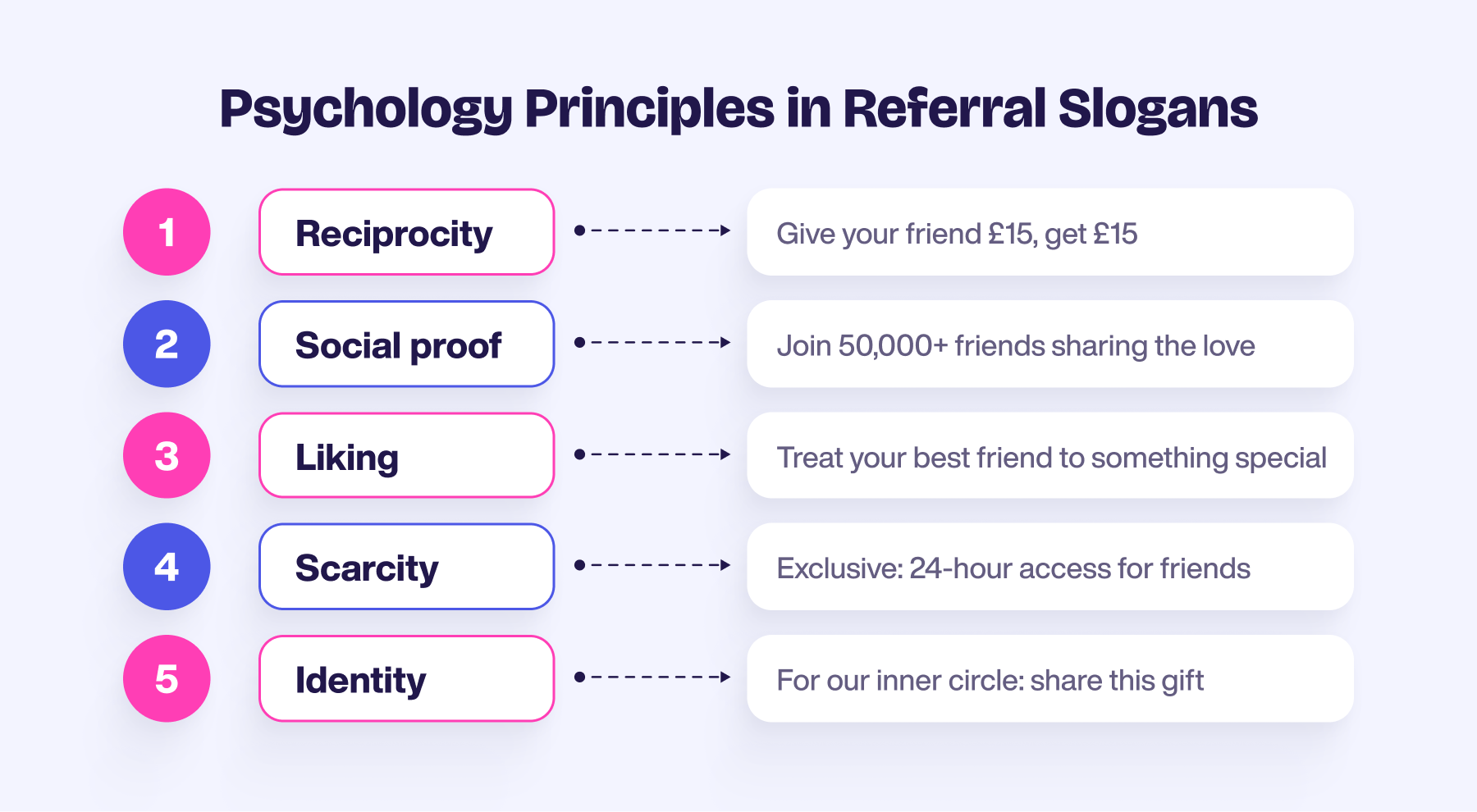
Robert Cialdini's principles of persuasion map almost perfectly onto referral programme design. Each one explains a different reason humans share — or stay quiet — and each offers a direct blueprint for writing stronger slogans. Here is how they translate in practice.
Reciprocity: Give Before You Ask
People feel a deep-rooted obligation to return favours, and referral programmes that lead with giving something to a friend activate reciprocity on both sides simultaneously. The referrer feels generous rather than self-serving. The friend feels the brand deserves a fair shot. Slogans framed as acts of giving — "Give £20, get £20" — consistently outperform ones that lead with the referrer's own reward, because they reframe the entire act of sharing as generosity rather than a personal cashout. That single shift changes how the referrer imagines the conversation going with their friend, which is the real moment the decision gets made.
Social Proof: Show Them Everyone Is Doing It
Humans instinctively look to others when uncertain, and a referral slogan that references community size or shared momentum reduces the hesitation customers feel before sharing. "Join 50,000+ customers who love us" works because it answers an unspoken question: is this something people like me actually do? Layering social proof into referral copy can lift conversion rates by 5–25%, simply because knowing that others are already participating makes the act feel safer, smarter, and more normal.
Liking: Make Sharing Feel Like Friendship, Not Selling
People recommend brands that make them look good and say yes to people they like. A referral slogan should always position the customer as a thoughtful, generous friend — not a sales affiliate collecting commissions. "Be a best friend, share the love" lands in an entirely different emotional register than "Earn cash for every referral." The first feels warm. The second feels mercenary. When customers sense that sharing might make them look pushy or self-interested, social risk becomes the biggest barrier to participation — and friendship language is the most reliable way to remove it.
Scarcity and Urgency: Create a Reason to Act Now
Time-limited referral offers create a sense of FOMO that open-ended programmes simply cannot replicate. "This weekend only: give a friend a free starter kit" creates a decision deadline that moves customers who would otherwise bookmark the page and forget about it entirely. The essential caveat is authenticity: countdown timers that reset every Monday and "limited time" offers that run indefinitely teach customers to dismiss urgency signals on sight. Real scarcity, tied to a genuine seasonal or campaign moment, builds trust while accelerating action — and the best refer a friend programmes plan these windows deliberately rather than leaving urgency as an afterthought.
Identity and Belonging: Make It About the Tribe
People share things that reinforce who they are and what groups they belong to. Slogans built around shared values and community — "Help us spread the word about kinder living" or "We are looking for customers just like you" — tap into a desire for belonging that goes far deeper than any discount code. This is especially powerful for brands built around a lifestyle, a cause, or a strong community identity, where the act of sharing is itself a signal of membership. Customers who feel part of something bigger are more likely to refer, and the customers they bring in tend to be more valuable over time.
Referral Slogan Examples That Apply These Principles (With Analysis)
The table below breaks down ten real referral slogans from brands running live programmes, by the psychology principle at work, and why the specific wording earns its place. The strongest examples consistently make the social act feel easy, generous, and reputation-safe all at once.
|
Brand |
Referral Slogan |
Psychology Principle |
Why It Works |
|
Dropbox |
Get 500MB by inviting your friends |
Reciprocity |
Both sides receive extra storage, so sharing feels like passing on a useful gift rather than chasing a personal perk. |
|
ALOHAS |
Be a best friend, share the love, and get [benefit] |
Liking |
Positions the referrer as a caring friend first, with the reward mentioned second — which is exactly the right emotional order. |
|
Huel |
Give £10, get £10 |
Reciprocity |
The symmetry signals fairness instantly. Both parties win the same amount, which removes any hint of one-sidedness from the act of sharing. |
|
Casper |
Give your friends £75 off their first mattress |
Liking |
The friend's benefit comes first entirely. The referrer looks generous rather than transactional, which makes them far more likely to actually share the link. |
|
Little Spoon |
Spoon the love |
Identity & Belonging |
A brand-specific pun that only works for this brand. It signals authenticity and community membership in three words. |
|
A Box of Stories |
Share the story, share the love |
Identity & Belonging |
Speaks directly to reader identity. Sharing feels like expanding a beloved book community, not promoting a subscription box. |
|
Future Kind |
Help us spread the word about kinder living |
Identity & Belonging |
Frames sharing as a values-driven act. Conscious consumers want to be associated with that mission — the reward feels almost secondary. |
|
Brewsy |
Limited time: give a friend a free starter kit |
Scarcity & Urgency |
A real time-bound offer paired with a tangible gift creates immediate motivation. The urgency feels genuine rather than manufactured. |
|
Anyday |
Join 40,000+ home cooks who share the love |
Social Proof |
The community figure does the persuasion work instantly. If tens of thousands of people are in, hesitation drops, and curiosity kicks in. |
|
Fidelity |
Refer a friend, and you both get a cash reward |
Reciprocity |
"Both" is doing the heavy lifting. It eliminates any one-sidedness and makes sharing feel like an act of mutual generosity rather than a sales pitch. |
How to Write a Referral Slogan That Actually Works
The brands above share a handful of habits in common — and once you can see them, they are practical to apply to your own referral programme wording.
Lead With the Friend's Benefit First
Double-sided incentives consistently outperform one-sided ones, but the order in which you present them matters just as much as the amounts. When a slogan leads with what the friend receives, the referrer reads the act of sharing as an act of generosity rather than a personal cashout. That single shift removes the social awkwardness of passing on something that could otherwise look self-serving. "Give your friend £15 off their first order — and get £15 yourself" lands completely differently from "Earn £15 when a friend signs up," even though the economics are identical. The first invites people to be a good friend. The second invites them to be a commission earner. Getting this order right is one of the simplest and most impactful changes any referral programme can make.
Keep It Short Enough to Read at a Glance
Six to ten words is the sweet spot for catchy referral slogans — short enough to land before the customer has time to second-guess, long enough to carry a complete thought. Active verbs do the most work here: Share, Give, Invite, Unlock, Spread, Tell. They create forward momentum in the sentence and signal that something easy and rewarding is available right now. Every word beyond what is necessary adds a tiny moment of cognitive friction, and in referral marketing, tiny friction compounds quickly. The slogans with the highest recall rates are almost always the ones a customer could repeat from memory within ten seconds of reading them.
Write Like a Trusted Friend, Not a Loyalty Scheme
Referral copy either feels like a recommendation from someone who cares or an alert from a points dashboard — and customers feel that difference immediately. Words like "commission", "incentive value", and "programme completion" belong in a terms and conditions document. Words like "love", "friends", "share", and "give" belong in a referral slogan.
People are acutely aware of their social reputation, and if sharing feels like hawking a product, they protect that reputation by staying quiet. The best refer-a-friend promotion wording gives customers something they would genuinely want to say to a friend — not something that sounds like it was written by a compliance team. Advocacy-led copy consistently outperforms transactional copy for exactly this reason: it taps into how customers already feel about a brand, rather than trying to manufacture a feeling from scratch.
Let Your Brand Personality Show
Generic slogans produce generic participation rates. The brands with the strongest referral programmes write copy that could only come from them — Little Spoon's "Spoon the love" is the perfect example, a three-word pun that is instantly recognisable and completely un-stealable. Brand-specific language works because it deepens the identity connection customers feel when they share.
They are passing on something that says something about who they are, not just forwarding a discount code. A pun, a community phrase, a brand value expressed in plain English — any of these can turn a forgettable prompt into something customers genuinely enjoy sharing. This is also where refer-a-friend campaign ideas that align with seasonal moments or brand milestones tend to outperform evergreen templates.
Test, Learn, and Rotate
Small wording changes produce surprisingly large shifts in participation rates, which means the only way to find your highest-performing slogan is to run variants and measure them properly. Test the benefit amount, the tone (warm and playful versus clear and direct), the urgency frame, and the order in which you present the give and the get. Mention Me’s referral platform is built to make exactly these experiments easy to run at scale, surfacing which combinations drive the most shares, clicks, and completed referrals. Rotate your top performer periodically, too — even the best referral programme wording sees diminishing returns once your most active customers have seen it several times.
Common Referral Programme Wording Mistakes to Avoid
Even well-funded referral programmes can lose momentum when the copy makes one of these classic errors. Spotting them in your own messaging is usually the fastest route to a meaningful improvement.
- Being too vague. "Tell your friends!" gives a customer no incentive, no emotional hook, and no clear action. Every great referral slogan answers three questions in one breath: what do I do, what does my friend get, and what do I get?
- Focusing only on the referrer's reward. Hiding the friend's benefit — or leaving it out entirely — is a missed psychological lever. People share things that make them look good, and leading with what their friend receives is what makes sharing feel genuinely generous.
- Using corporate or transactional language. Referral copy should sound like something a good friend might say, written in the brand's own voice. The moment it starts reading like a terms sheet, the emotional case for sharing evaporates.
- Overcomplicating the offer. If a customer has to read the slogan twice to understand what is being offered, the moment is already lost. Simplicity is the most underrated asset in referral copywriting.
- Manufacturing urgency that keeps resetting. Fake countdowns and perpetual "limited time" offers teach customers to dismiss urgency signals entirely. When there is a genuine time-bound moment, use it — and mean it.
Conclusion
The best referral slogans are socially intelligent, not just cleverly worded. Reciprocity, social proof, liking, scarcity, and identity are the forces that determine whether a customer shares a link or closes the tab, and each one has a direct translation into the words on a referral page. Lead with the friend's benefit, write in the language of friendship rather than finance, keep it short enough to share in a single glance, and make it sound unmistakably like your brand. Then test, because even a single word swap can shift results in ways that consistently surprise even experienced referral teams.
Take your existing refer-a-friend promotion wording and hold it against the principles covered here. Chances are there is at least one quick adjustment that could meaningfully lift participation rates — and that is almost always the most valuable place to start.
Ready to put these principles into action?
Explore the Mention Me referral platform →
Download the Psychology of Recommendations white paper →
Frequently Asked Questions
What is a referral slogan?
A referral slogan is the headline or catchphrase a brand uses to encourage existing customers to recommend their product or service to friends. It appears on referral landing pages, emails, banners, and in-app prompts. The best ones are short, benefit-led, and written in friendship language rather than transactional sales speak.
What is the best wording for a refer-a-friend promotion?
The best refer-a-friend promotion wording leads with a double-sided benefit such as "Give £10, get £10", uses warm language like "Share the love", and stays under ten words. Reciprocity and social proof are the psychological engines behind top-performing copy, so always make the friend's reward visible — not just the referrer's.
How does social psychology influence referral programme success?
Principles like reciprocity, social proof, liking, scarcity, and identity all shape whether a customer shares or stays quiet. When referral programme wording taps into these instincts — making people feel generous, part of a community, and socially safe — participation rates rise significantly compared to copy focused only on mechanics.
What are examples of catchy referral slogans?
Standout catchy referral slogans include Dropbox's "Get 500MB by inviting your friends", Huel's "Give £10, get £10", ALOHAS's "Be a best friend, share the love", and Little Spoon's "Spoon the love". Each one leads with a clear benefit, uses warm language, and sounds true to the brand's own personality.
Dan Barraclough
Read more >
Share:



.png)
Table of contents
Share: