Why Referrals are Important: The Psychology Behind Customer Recommendations
By Andy Cockburn —
To understand why referrals are important, you first need to look at human behaviours and social dynamics. Referrals work by leveraging social proof as people look to the actions and opinions of others to guide decisions. They also strengthen bonds and trigger reciprocity, motivating customers to share.
When brands design with these drivers in mind, referral programmes feel authentic, resonate with customers, and lift loyalty, conversion, and sales. The best programmes go beyond incentives: they boost social rewards, respect the nuance of relationships, and reduce friction and risk.
Ultimately, referral marketing runs on connection: trust between people, not just promotions. Build for that human reality and you’ll create a scalable, profitable growth channel.
Why are referrals important in marketing today?
Referrals are important because they rely on genuine, person-to-person recommendations, not paid reach. When someone shares a brand with a friend or family member, it carries the weight of lived experience and social proof.
That trust gap between what an advert says and what a loved one believes to be true is vast; a friendly nudge from someone you know and respect will always feel more credible than a campaign vying for attention in a crowded feed.
Referral marketing campaigns leverage the social connections and relationships that consumers have, transforming them into potent referral tools. The credibility gained from a personal recommendation often surpasses that of traditional advertising, as people are more likely to trust the opinion of someone they know.
Just as importantly, referrals influence decisions at moments ads can’t reach. They happen in private spaces and high-intent moments (group chats, dinner tables, office corridors, checkout queues) precisely when people are choosing what to buy next.
Why are referrals important for business growth?
From a commercial lens, referrals are important because they deliver efficient, compounding growth. They typically drive a lower customer acquisition cost than paid channels, because you’re harnessing advocacy rather than outbidding competitors. That built-in trust also translates into higher conversion rates: referred prospects arrive pre-qualified by someone they know, so they move from consideration to purchase faster.
The upside doesn’t stop at acquisition. Referred customers tend to show stronger retention and repeat-purchase behaviour, improving lifetime value and payback. And because happy customers create more happy customers, referrals scale as a durable acquisition channel that you can optimise over time with targeting, incentives and testing.
To operationalise this at pace and prove ROI, a purpose-built referral platform helps you launch, measure and iterate programmes that keep the flywheel spinning.
Why we crave connection (and why referrals work)
"More than features, more than benefits, we are driven to become a member in good standing of the tribe. We want to be respected by those we aspire to connect with, we want to know what we ought to do to be part of that circle." - Seth Godin
Human beings are inherently social - we crave connection. Social connections are the cornerstone of referral marketing campaigns, serving as the conduit through which recommendations and trust flow. We’re hardwired to seek out community and become part of “our tribe”. The connections, whether they be family, friends, or even colleagues, are built on a foundation of trust and shared experiences.
When a product or service is recommended within this trusted network, the endorsement carries significant weight, often surpassing the credibility of traditional advertising. The interconnectedness of social circles means that a single recommendation can ripple outwards, potentially reaching a vast audience. In this way, social connections act as amplifiers for referral marketing programmes, multiplying their impact and effectiveness.
Our appetite for kinship means we’ll accept the risks involved in taking a social action if we can anticipate the recognition (the social approval and strengthened social bonds that can result from making a good recommendation). We’ll take a leap of faith.
But there’s a limit. Because we’re also inherently scared of rejection. If the risk of not getting a positive response from our social action outweighs the potential reward, our self-preservation kicks in. We go into our shells, reluctant, more inclined to stay quiet.
The choice between taking a leap of faith, or retreating into our shells, is based on one thing. Trust.
Why trust makes referrals so powerful
Whether we’re aware of it or not, any time we weigh up a social action (the act of recommending a product or service within one's social network), we have an internal narrative. It goes something like this:
"How big is the risk of this action being rejected?" vs. "How confident am I that this action will be recognised and rewarded?"
And it’s this exact psychological dynamic (weighing the potential social rewards against the risks of rejection) at play in referral marketing campaigns. After all, referring a product or service among friends is an act of social belonging, reciprocity and trust.
That’s why the attraction of refer-a-friend programmes goes far beyond financial benefits. They tap into a much deeper human need for social recognition and belonging. And that’s why understanding your customers’ psychology, and tailoring your referral campaigns accordingly, is so important.
Trust is the bedrock upon which all successful referrals are built. When a customer trusts a brand, they are not only more likely to become repeat buyers, but also more likely to recommend the brand to others.
This word-of-mouth recommendation is invaluable, as people tend to place a high degree of trust in the opinions of friends and family. A referral from a trusted source can often be the deciding factor that convinces a prospective customer to choose one brand over another, showing why referrals are important for reaching new, high-intent customers.
Building trust with customers is a crucial aspect of any business strategy. This involves not just delivering a high-quality product or service, but also ensuring a positive customer experience, maintaining transparent communication, and addressing any concerns or issues promptly and effectively.
By building a strong relationship of trust with customers, businesses can create a loyal customer base that is likely to make repeat purchases. These satisfied customers can then act as brand ambassadors, referring others and driving organic growth.
The psychology behind referrals: Balloons and weights
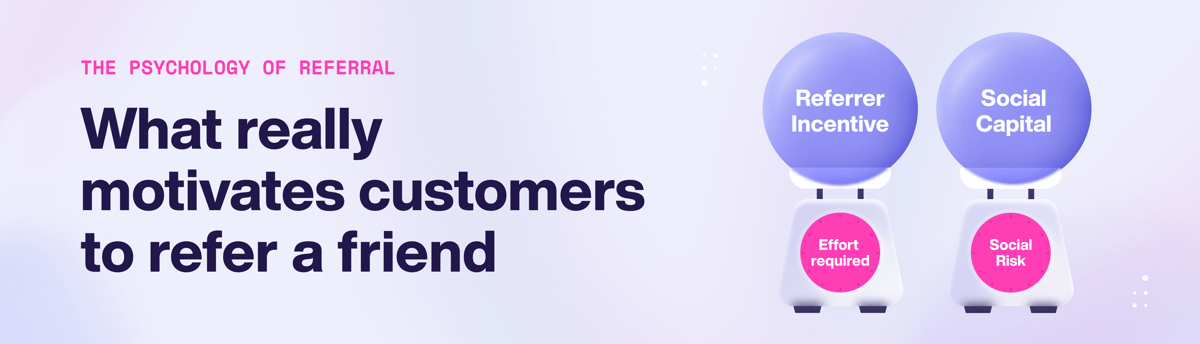
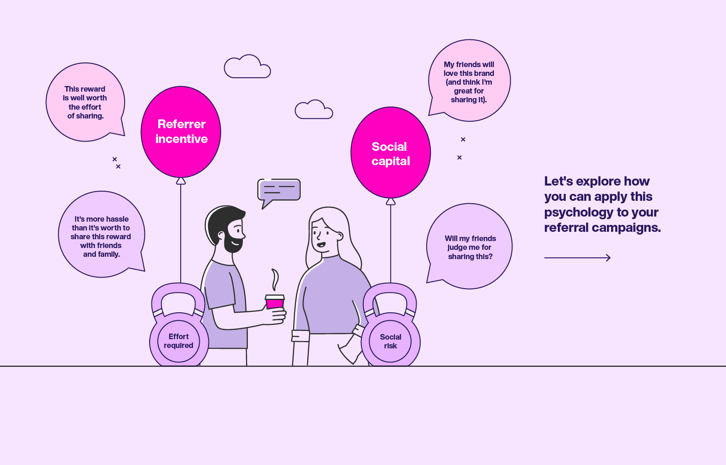
We like to look at the psychology behind a customer's propensity to refer as balloons and weights.
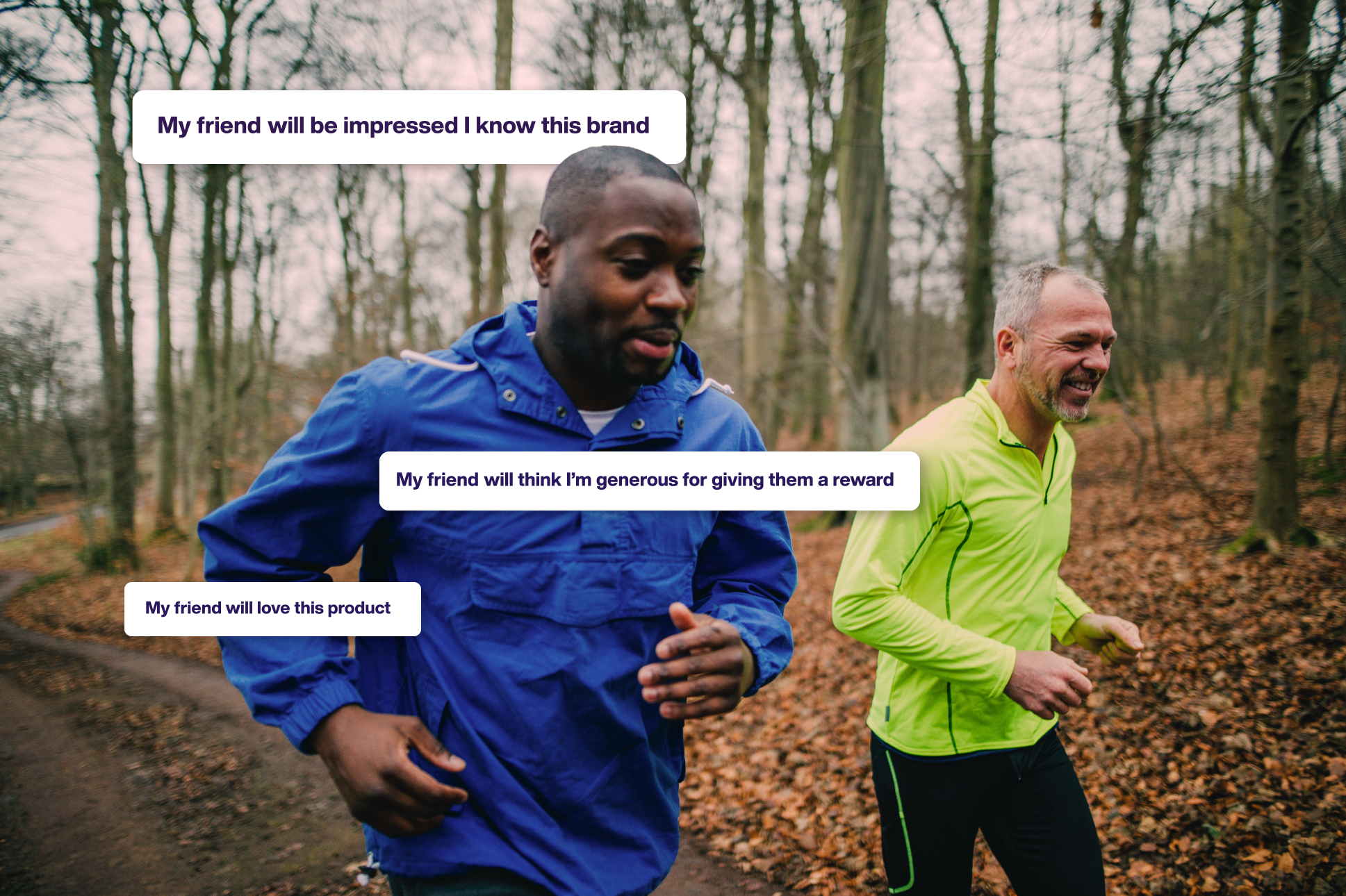
Two things play a decisive role in increasing the chances your customer will commit to a referral marketing programme: referrer incentive and social capital. These are our psychological balloons. They trigger positive emotions for your customers.
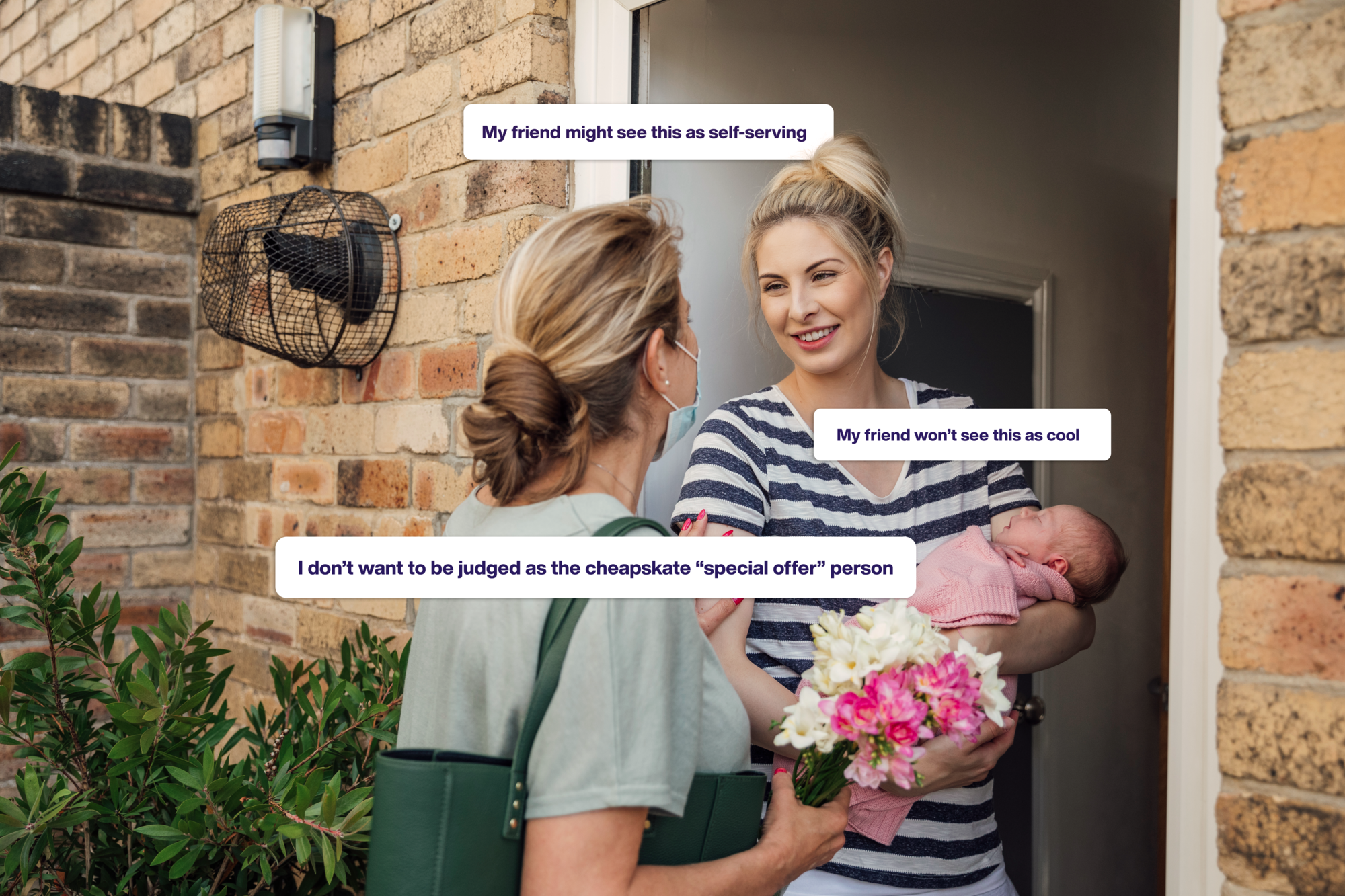
On the other hand, there are also two factors that can decrease your chances of a successful referral: effort required and social risk. We call these psychological weights. They trigger uncertainty and doubt in your customers’ minds.
The more you can inflate the psychological balloons for your customers, while lightening the psychological weights, the more likely they are to refer your brand. By understanding and leveraging these psychological factors, you can design a referral programme that truly resonates with your customers and drives results.
Let's take a closer look at these 'balloons' and 'weights' to understand their roles in a customer's decision to refer.
Referrer incentive: Do I really want this?
The concepts of motivation and reward are integral to understanding why referrals are important.
Motivation propels customers to take the desired action of making a referral, while rewards or 'refer a friend bonuses' serve as an acknowledgment and appreciation of their effort. These refer a friend bonuses, be they discounts, freebies, or other incentives, can create a positive feedback loop that further encourages referrals.
The prospect of receiving a reward adds an additional layer of motivation, enhancing the likelihood that customers will engage in the referral behaviour. This dynamic interplay between motivation and reward is a key driver behind the efficacy of referral marketing programmes.
Choosing the right incentives is a crucial component in motivating customers to refer a friend.
Your incentive needs to be something your customers really want. It has to be worth their while. It needs to provide a compelling reason for them to engage in the referral behaviour. When the reward aligns with the customer's preferences and interests, it creates a stronger motivation to participate in the referral programme.
The incentive should be proportional to the effort required to make the referral. If the referral process is simple and straightforward, a smaller incentive may be enough.
If the process is more complex, a larger reward may be necessary to motivate customers. Incentives can be tailored to encourage specific behaviours, like offering a higher reward for referring multiple friends or for referrals that result in a purchase.
Ultimately, the right incentive can significantly enhance the appeal of a referral programme, driving customer participation and ultimately leading to increased sales and brand exposure. Businesses should carefully consider their audience and what motivates them, testing and refining their incentive offerings to maximize their effectiveness.
Refer-a-friend incentives can take many forms, each with its own advantages and effectiveness in encouraging customer referrals.
Customer referral incentives
Incentives matter because they speak to human psychology, not just mechanics. A well chosen reward validates the act of sharing, triggers reciprocity, and boosts the referrer’s social capital. It reduces the mental cost of taking action and reframes a recommendation as a helpful gift.
When the reward feels relevant and fair, people are more motivated to refer and more confident their effort will be appreciated.
Discounts
Discounts deliver instant, relatable value and encourage repeat purchase. Tailor the offer to segments and context, testing percentage versus fixed amounts to find what feels most rewarding to your audience.
Cash rewards
Cash or gift cards are clear, flexible, and widely motivating. They suit diverse audiences and make the payoff obvious, which increases willingness to share.
Free products or services
Free access lowers risk and lets friends experience the product firsthand. Trials or bonus items turn curiosity into commitment and create a natural reason to talk.
Loyalty points
Points tie referral to ongoing value. They reinforce habit, increase retention, and make each share feel like progress toward a meaningful reward.
Charitable donations
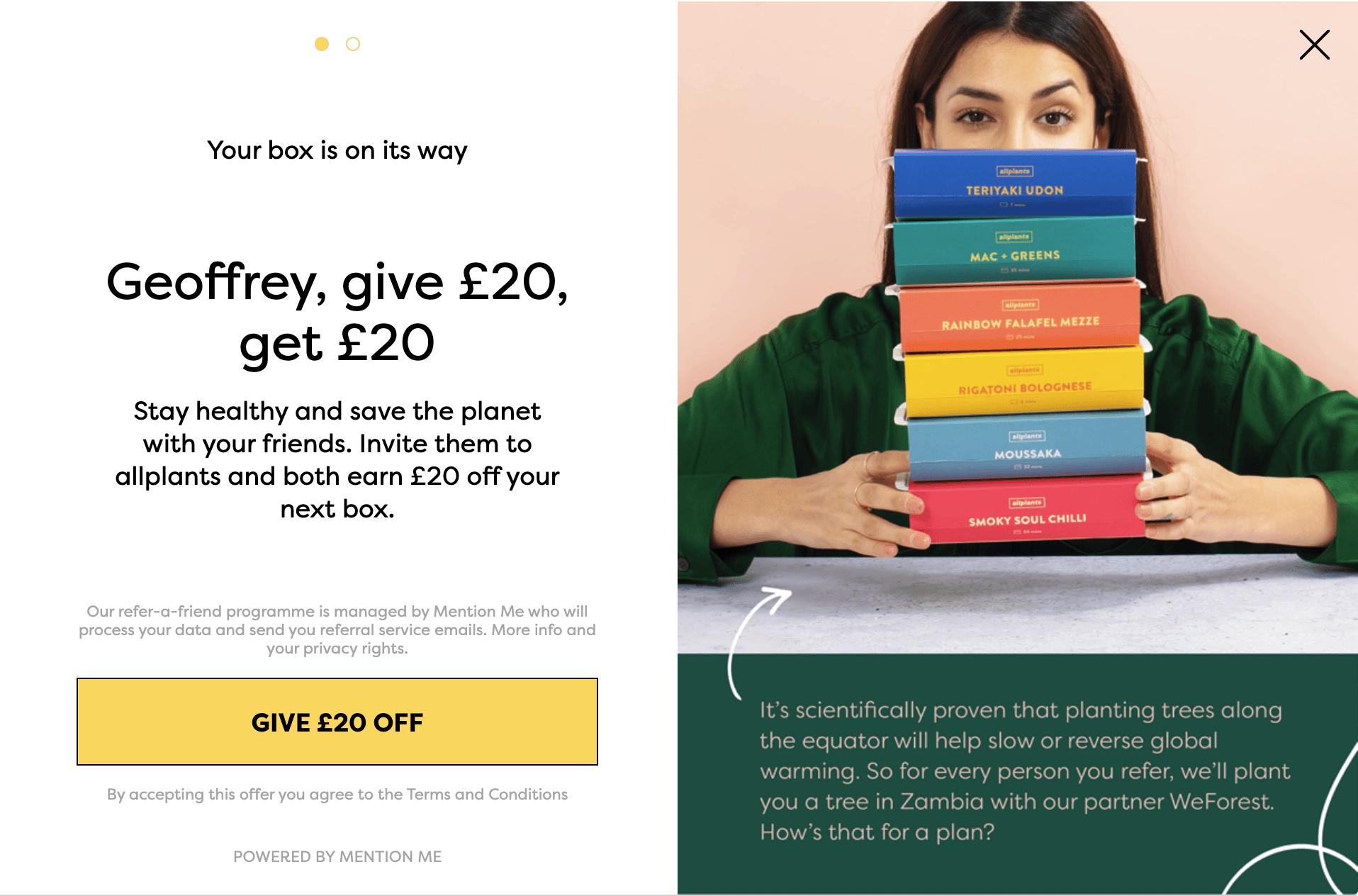
Donations align the act of sharing with purpose. They lift social capital by letting customers do good for others while recommending a brand they trust.
Prize draws
Prize draws add excitement and buzz. High perceived value can spark broad participation, especially when entry is simple and winners are announced consistently.
allplants plants a tree for every successful referral
Once you find an incentive that drives customers to refer, you can drill deeper; experimenting, for example, with offering £10 off versus 10%.
The only sure-fire way to know which incentives work well with your customers is to test. Start with a hypothesis about the kinds of offers that could work for your audience. Then, for the best results, segment your audience and run strategic A/B tests by cohort for each to optimise your conversion offer.
Effort required: How easy is it to get this reward?
Whether we’re on or offline, we’ve become accustomed to convenience. So, today, anything that creates extra effort or hassle is a big barrier to commitment.
For instance, if a customer has to navigate through multiple pages, fill out lengthy forms, or wait for confirmation emails, they might decide that referring a friend is too much trouble, no matter how attractive the incentive may be.
This gives you a simple but significant takeaway: the quicker and easier you make it for customers to get your offer, the much more likely they are to share it.
This means serving up a smooth user experience is non-negotiable. How many steps does your customer need to take to sign up? Are you asking for data you don’t really need?
For example, if you're running a simple refer-a-friend programme, you might only need your customer's name and email address, along with their friend's email address. Asking for additional information, such as physical address, phone number, or date of birth, could be seen as unnecessary and may deter customers from completing the referral process.
Streamline each step to make life convenient for your customers (and boost your referrals in the process).
The ease of the referral process is crucial to its success because it directly affects the customer's willingness to participate. A simple, straightforward process minimizes the time and effort required from the customer, thereby removing potential barriers to participation.
If a referral process is complex, time-consuming, or requires multiple steps, the potential referrer might be deterred from doing so. This is because people naturally tend to seek convenience and avoid tasks that seem like a lot of effort.
On the other hand, of course, if the referral process is straightforward, simple, and requires minimal effort, the individual is much more likely to go ahead with the referral.
When customers can easily share a referral link or code with minimal steps, they are more likely to engage in the referral behaviour. Conversely, a complicated or time-consuming process can deter customers from referring, regardless of the incentives offered. Businesses should prioritise creating a user-friendly referral process to maximise customer participation and harness the full power of referral marketing.
Social capital: Will this make me look good?
While incentives and smooth experiences are important, social capital – and connection – is the beating heart of any successful referral campaign. If your customers are confident they’ll come out of the interaction looking good (while getting the added bonus of a reward), they’re likely to share your offer.
You can increase your campaign’s success by reinforcing these positive feelings throughout your copy, messaging and design of the referral journey. Put yourself in your customers’ shoes and play up to their inherent desire to look good.
Social capital is a key motivator, as a successful referral can significantly enhance one's social standing and reputation within their circle. When a friend's recommendation results in a positive experience, it boosts the referrer's credibility and elevates their status, making them a valuable source of information for others.
This positive outcome not only strengthens social relationships but also provides the referrer with social currency. This valuable social asset can then be traded for favours, support, or other forms of social capital, further enhancing the referrer's social standing and relationships.
The impact of mental health on referrals
It’s easy to talk about motivation like it always runs on logic and reason. But in reality, our decision-making, especially around social actions like referrals, is heavily influenced by emotional bandwidth and overall mental wellbeing.
When people feel anxious, overwhelmed, or isolated, they’re less likely to engage in outward-facing behaviours. That includes sharing recommendations, even if they’re happy with a brand.
Referrals, after all, require optimism and connection. They are a social gift: “I want to bring you into something good I’ve found.” But when someone feels emotionally depleted, that leap into reciprocity may feel far too steep.
That’s why empathy and timing matter.
Your most loyal customers may not always be ready to refer immediately. Offer reminders (not just once, but thoughtfully) and always keep the tone warm, respectful, and human.
You can also reduce emotional friction by making the referral message feel like a kind gesture. For example, “Your friend gets something too” is more emotionally compelling than “Invite someone and earn a reward.”
Taking mental health into account doesn’t mean you have to overcomplicate your messaging — it just means recognising that people are complex, and referrals hinge on their emotional state as much as their satisfaction level.
Social risk: Will this be received negatively?
"If it isn't crystal clear how your offer will benefit your customers and increase their social capital, they may start to weigh the social risks. These risks, characterized by tension and reluctance, can outweigh the rewards of recommending your brand, thereby decreasing your conversion rate. In the minds of your customers, thoughts such as "What if my friend has a bad experience?" or "Will this recommendation harm my reputation?" can arise.
The best way to mitigate these concerns is to prevent them from occurring in the first place. Create a clear and compelling offer that leaves no room for doubt in your customers' minds.
When someone refers a friend, they are essentially vouching for the product or service, putting their own reputation on the line. A positive experience can enhance the referrer's social standing and strengthen their relationship with the friend, while a negative experience can do the opposite.
This perceived social risk can make individuals more cautious about making referrals. To minimise this risk and encourage more customers to recommend your brand, it's crucial to ensure that your products or services meet customer expectations and deliver a positive experience.
Ultimately, the psychological factors that influence customer behaviour, such as social capital and social risk, play a significant role in motivating customers to make referrals.
Overcoming barriers to referrals
Even customers who love your brand might not refer - not because they don’t want to, but because something is getting in the way.
Understanding and removing these barriers is essential to unlocking your programme’s full potential.
Let’s revisit those psychological weights:
Effort: Is your process unnecessarily long or filled with form fields that feel intrusive?
Social risk: Are your customers unsure how the offer will be perceived?
Timing: Are you asking at a moment when your customer hasn’t yet built trust?
Often, the biggest barrier is uncertainty. “What happens after I refer?” If people don’t confidently understand the process, they’ll freeze.
So your job is to make everything frictionless and clear. Spell out the reward. Show both the giver and receiver the benefit. Make sharing feel like a no-brainer.
Even small UX changes can have a big impact. Pre-filled content, smart defaults, easy sharing buttons, personalisation. These details build confidence and momentum.
And don’t overlook copy. A message like “Make their day: Give £10 off their first order” feels more emotionally intuitive than “Refer a friend.”
Removing obstacles is about mapping the path from liking your brand → to understanding the referral offer → to believing in the social benefit → to taking action.
Why referred customers are more valuable
Referred customers arrive with built-in trust and a strong problem–solution fit. That confidence shortens time to first and second purchase, increases spend, and deepens loyalty, which compounds value across their lifecycle.
Higher CLV
Referred buyers reorder more often, churn less, and expand into more categories. Learn how referral lifts customer lifetime value.
Higher AOV
A trusted introduction reduces perceived risk, making larger baskets and premium upgrades feel like smart choices.
Higher retention
Clear expectations and an early positive experience create habits that keep customers coming back.
More likely to refer again
A great referred experience turns customers into advocates, creating a self-reinforcing acquisition loop.
Quantify these effects by tracking cohorts over time, then reinvest in the segments and offers that deliver the strongest payback.
How to measure the value of referrals
Successful referral marketing is all about learning, iterating, and optimising. To do that, you need the right metrics to understand what’s working and where you can improve.
Here’s what to track:
Conversion Rate: Out of all the people invited, who signed up or purchased? This helps you understand the effectiveness of your messaging and incentive.
Share Rate: How many participants shared the programme in the first place? A low share rate could point to friction in your process or a lack of compelling value.
Customer Lifetime Value (CLV) of Referrals: Are referred customers more loyal or valuable than average? Often, referral-acquired users stick around longer and spend more.
Time to Conversion: How long does it take for referred friends to act? Faster timelines often signal a resonant and well-communicated offer.
Incentive Redemption Rate: Are people actually using their rewards? If not, it may indicate that your incentive isn’t relevant or clear.
Don’t just measure the “how many”. Look deeper into the “why.” Find where customers are dropping off. Use heatmaps. Gather qualitative feedback. And above all, keep looping learning back into action.
Referral marketing is a live system. Measuring success isn't just about the end result; it's about building a clearer map to connection, motivation, and loyalty.
Social capital should sit at the heart of your referral campaigns
To create successful referral marketing campaigns, you need to hit your customers' sweet spot. This means not only finding an enticing referral reward that grabs your customers' attention but also crafting compelling messaging that plants the seed of social capital in your customers' minds.
Social capital, or the network of relationships and the value they bring, is the most influential psychological trigger to referral success. Unfortunately, it's often overlooked by marketing teams focused on the mechanics of an incentive and the user journey around it.
While these elements are undoubtedly important, they miss out on the true heart and soul of the offer—the human connection and the emotion-fuelled psychological factors that convince customers of the socially beneficial outcomes of participating in the referral marketing programme.
Conclusion: Why referrals matter more than ever
At its core, referral marketing isn’t about tech platforms or eye-catching discounts.
It’s about people. Relationships. Psychology.
Your customers don’t refer just because there’s something in it for them. They refer because of trust, because of connection, and because your brand has given them a reason to feel emotionally engaged enough to share.
When you understand what motivates a customer to share, and what might prevent them, you gain powerful insight into behaviour. That insight can fuel programmes that do more than hit KPIs; they build tribes and movements.
So next time you're designing (or refining) a referral marketing campaign, zoom out. Think socially. Think emotionally. Think human.
And always, always, think about trust.
Want to explore the psychology of referral in even greater depth? Book a free demo of Mention Me to discuss things further with our experts.
Customer Loyalty vs. Customer Retention: Getting the Most out of Both
Read our blog post on navigating the differences between loyalty and customer retention. Discover how to turn customers into loyal advocates who come back often!



 allplants plants a tree for every successful referral