How to Drive Customer Retention with Advocacy Marketing
By Rhys Williams —
Read time: 6 mins
Retaining your customers in a crowded online landscape is hard. For many brands, one of the most challenging parts of customer retention is understanding what’s driving customer decisions.
This is for two main reasons:
Retaining customers means getting them not to do something (ie., churn). Measuring something that hasn’t happened is, well, tricky! If you’re a business that relies on repeat customers, how long do you leave it before you consider your customers as having churned?
It’s very difficult to know what causes retention. Did that customer make another purchase because they got an expertly-timed email, or because they needed a replacement item quickly and you were the most convenient option? Are your customers hanging around because they’ve got nowhere better to go, or is it because they’re genuinely engaged with and love your brand?
Customer advocacy data can help you with these problems. It gives you an extra layer of insights on top of buying activity that gives you deeper understanding of what your customers are thinking and feeling.
By collecting and analysing your customer’s advocacy signals — those activities they take on their own initiative to promote your brand — you get insights into who your biggest fans are, who your most valuable customers truly are, and who it’s worth spending valuable marketing budget on retaining.
How Advocacy directly improves customer retention
When recommendations come from trusted friends and family, uncertainty fades. Advocacy connects your brand to those social circles, building confidence in every purchase. Trust shortens the path to the next order and lifts retention.
Positive word of mouth strengthens emotional bonds with your brand. Hearing real stories from peers validates choices and creates a sense of belonging. That feeling of pride and reassurance keeps customers coming back.
Advocates typically form higher-value cohorts. They buy more often, spend more across their lifetime, and show steadier repeat behaviour. Your LTV curves improve because the customers you acquire and retain through advocacy are more committed.
A well-run advocacy programme keeps engagement alive between purchases. Referrals, reviews and social sharing create a virtuous loop that rewards participation and nudges the next action. Over time, those small touches turn satisfied customers into long-term loyalists.
The Fundamentals of Customer Retention
Understanding what motivates your customers and their buying decisions is fundamental to retaining their business. You can access these powerful customer insights by putting in place some basic customer retention best practices.
Build customer segments Begin by segmenting your customers based on their behaviour data, purchase history, and customer profiles. For example, you could segment customers based on their frequency of purchase (one-time buyers vs. repeat customers), the type of products they purchase, their average purchase value, their geographical location, or even their propensity to refer others.
Identify high-value and at-risk segments: Use segmentation to identify which customers are bringing the most revenue to your business, as well as those who are at risk of churning.
Create personalised communication: Tailor email campaigns, reward programs, or other outreach efforts to each segment's needs and preferences. For example, you could target at-risk customers with re-engagement campaigns, while rewarding high-value customers with exclusive offers or VIP benefits.
Tailor your CX: Customers respond differently depending on where they are in the buying cycle, so crafting a varied customer experience for each segment improves satisfaction and customer retention. For example, you could offer personalised recommendations based on past purchases or browsing behaviour.
Test and iterate: When you get your retention strategy up and running, you’ll be constantly tweaking your segments, messaging, and CX. Over time, this iterative process will allow you to develop more effective, personalised customer retention strategies.
If you implement these steps, you’ll notice an immediate boost in how you understand, relate to and keep hold of your customers. But to see a lasting step change in customer retention, you need to layer in advocacy data.
Why you need advocacy to solve the retention puzzle
One of the reasons solving the retention problem is so hard is that it’s not always clear why you’re retaining, or not retaining, your customers.
Emotions drive decisions more than logic. When a recommendation comes from someone you trust, it carries warmth, context and a sense of belonging. Paid media works hard to create that feeling, but advocacy starts with it. Customers who feel understood and supported are far less likely to drift.
Social proof reduces risk. Seeing real people choose your brand normalises the decision and quietens doubts. Reviews, referrals and user stories act like signposts that say others have been here and loved it. That reassurance builds confidence that paid ads rarely match.
Having a segmentation strategy that identifies your biggest spending customers and those who haven’t purchased in a while is a great start, but it only tells you if they have or haven’t bought.
Only using purchasing data makes it very difficult to attribute retention numbers to specific campaigns or actions. It makes the job of CRM managers and customer leaders especially difficult — you are the ones who need to drive retention, but without the ability to prove your methods and attribute results you’re fighting with one arm tied behind your back.
How advocacy marketing builds stronger retention (core framework)
Below are four ways to build stronger retention using advocacy marketing. In 2026 and beyond, use this universal framework first, then lay on your platform specifics.
Identify and activate your brand advocates
Spot advocates by combining behavioural and sentiment signals. Look for successful referrals, review quality and recency, social sharing, NPS promoter status, community participation, and positive customer service feedback.
Overlay these with value markers such as purchase frequency, recency, average order value, margin contribution, and category fit. Segment into tiers like potential advocates, active advocates, and VIP advocates, then align activation to their brand affinity. Activate with clear asks, simple sharing tools, and rewards that feel fair and relevant to each segment.
Create advocacy triggers across the customer journey
Place intentional prompts at moments of maximum goodwill. Post‑purchase, invite reviews or referrals once delivery is confirmed and the product has been used. At unboxing, include a QR card, a small surprise, or a how‑to that invites sharing.
After helpful customer support interactions, follow up with a thank‑you and a low‑friction referral or testimonial request. Add extra touchpoints at anniversaries, replenishment windows, and milestone moments to keep the momentum going.
Use high-value social proof to reinforce decisions
Prioritise social proof that is specific, recent, and verifiable. Use detailed reviews, named testimonials with permissioned UGC, and referral quotes that speak to real outcomes. Place them where decisions happen, such as product pages, category pages, checkout, post‑purchase emails, and retargeting.
Match the proof to the shopper’s context, for example show size and fit reviews on apparel PDPs or durability stories for outdoor gear, to reduce doubt and nudge repeat purchase.
Make Advocacy Continuous, Not One-Off
Avoid short bursts of buzz that fade when a campaign ends. Build an always‑on advocacy programme that rewards frequent participation, not just a single referral or review. Use tiered recognition, surprise perks, rotating creative, and seasonal prompts to keep it fresh without fatigue.
Close the loop by thanking advocates, updating them on their impact, and inviting the next action, creating a sustained engagement cycle that compounds into long‑term loyalty.
How Mention Me supports retention through advocacy
Retention improves when your best customers feel seen, rewarded and heard, and when new customers arrive pre‑primed by people they trust.
Mention Me operationalises that loop: identify the customers who advocate, make sharing effortless, orchestrate journeys that reward advocacy, and optimise it all across channels so loyalty compounds. Learn more about Mention Me's retention prowess in the Trouva customer retention case study.
Identify your Tru-Promoters™
We surface the minority who drive the majority of your growth using behavioural, influence and value signals—successful referrals, review quality, UGC activity, repeat rate and LTV—to create a Tru-Promoters™ profile. This lets you prioritise high‑impact cohorts, tailor rewards and track retention and LTV at cohort level.
Turn word-of-mouth into measurable value with Name Share®
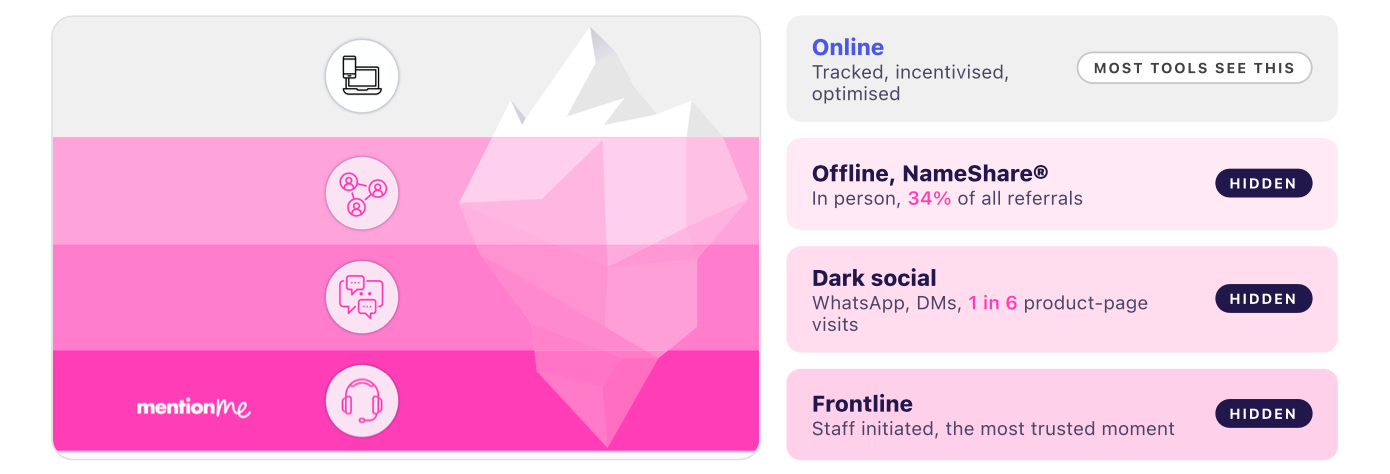
Our name‑sharing technology captures offline and casual recommendations that codes and links miss. Shoppers can redeem a referral by simply naming their friend at checkout, reducing friction, boosting trust (“referred by Alex”) and making previously invisible advocacy measurable. Two‑sided rewards reinforce the relationship for both advocate and friend, improving first‑to‑second purchase conversion and repeat rate.
Orchestrate journeys that earn and reward advocacy
We embed advocacy prompts where they feel natural and helpful—post‑purchase, order received, product delivered, milestone moments, replenishment and win‑back. Advocates see on‑brand, context‑aware asks; referred customers get tailored onboarding and social proof that speeds time‑to‑second purchase. Tiered benefits and recognition deepen loyalty without eroding margin.
Test and optimise share flows
Every share flow can be A/B tested: copy, creative, timing, placement, and incentive type (monetary, experiential, access). Compare WhatsApp vs email vs QR, one‑sided vs two‑sided, and short vs long windows. Optimise to the metrics that matter—share rate, friend conversion, K‑factor, time‑to‑repeat and cohort LTV—then scale the winners quickly.
Integrate advocacy across channels
Plug advocacy data into your ecommerce, CRM/ESP and CDP to personalise messaging and automate next‑best actions. Push approved UGC and reviews to PDPs, email and paid; sync advocate and referred cohorts to Meta/Google for smarter retargeting and lookalikes; and report end‑to‑end impact with clear, CFO‑ready retention and LTV dashboards. The result is a connected programme where human proof powers every channel and loyalty grows by design, not chance.
Data and insights that predict retention outcomes
Data is the link between a recommendation and a retained customer. With first-party and consented signals, you can attribute referrals, track cohorts over time, and prove that advocacy lifts repeat purchase and lifetime value.
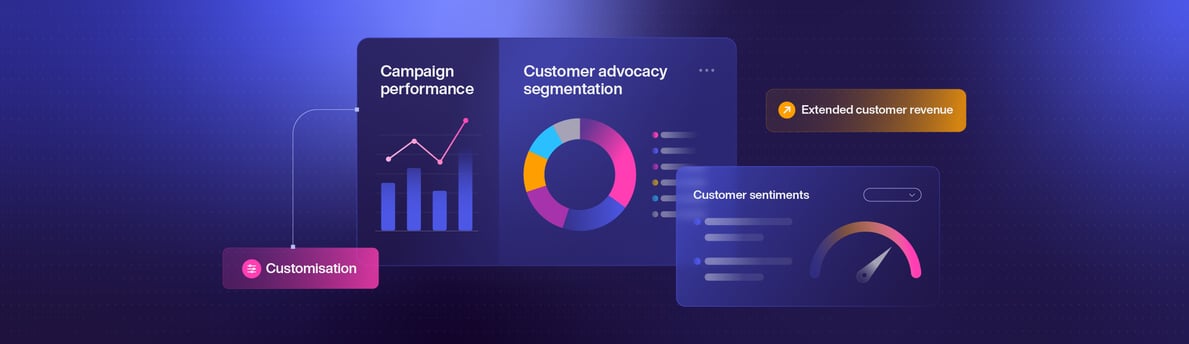
Sentiment analysis
Mention Me applies sentiment analysis to customer feedback and NPS scores, categorising common issues. This allows you to more easily take any necessary action. If, for example, your customers often complain about confusing website navigation, you can develop a plan to improve it.
NPS Performance Over Time allows you to see the impact of your actions on customer sentiment, helping you demonstrate the usefulness of your activities.
Extended customer revenue (ECR) data
Your customer’s ECR score shows you the total value they bring to your business when you take into account their own purchases, plus how much the people they refer spend.
Layering ECR data into your retention campaigns (with the ability to segment by high, medium and low ECR) gives you a much clearer idea of which customers are truly the most valuable. It also helps you identify the more transactional customers who may have made a significant purchase but are unlikely to shop with you again. This insight conserves your marketing budget, allowing you to target it where you’ll get the most bang for your buck.
Predicted ECR
Based on advocacy data, predicted ECR tells you how much value customers will bring to your business over the next 12 months. Not only does this help you allocate retention resources, it also reveals those customers who’s predicted ECR scores have dropped, alerting you to the potential for churn.
Best practices from advocacy-led retention programmes
Want to stay ahead of the brands your customers compare you with? Borrow what works, make it your own, and run it with discipline. Ready to close the gaps and turn advocacy into a habit rather than a hope?
Consistently share high-value content
Set a clear editorial rhythm. Publish how‑to guides, usage tips, customer stories, and product previews on a schedule. Repurpose across email, SMS, social, and packaging inserts. Track saves, shares, and repeat rate by content type to double down on what compounds loyalty.
Create dialogue with your customers (feedback loops)
Replace one-way updates with short polls, post-purchase check‑ins, and microsurveys after support. Close the loop by showing what you changed as a result. Ask one precise question at a time and reward thoughtful input.
Gamify advocacy (milestones, tiers)
Define milestones such as first referral, three verified reviews, or five approved UGC posts. Unlock tiers with meaningful perks like early access, VIP support, exclusive bundles, or community badges. Show progress in account areas and messages so customers see how close they are to the next win.
Use surprise and delight moments to boost loyalty
Time small, unexpected gestures at high‑emotion moments such as first re‑order, birthday month, or problem recovery. Think handwritten notes, bonus samples, free shipping upgrades, or store credit. Small cost, big story value. Did they tell a friend? Track it.
Encourage UGC for emotional connection
Make it easy to create by offering simple briefs, creator kits, and clear hashtags. Curate galleries on product pages and celebrate customers in newsletters. Always get consent, give credit, and prioritise real-life context that helps others picture success.
Measure each tactic against retention lift, repeat purchase rate, and cohort LTV. Keep what compounds. Retire what only creates noise.
Metrics that show whether advocacy is driving retention
You can't improve what you cannot measure. Start with clean baselines, clear cohort definitions, and a control group to prove incrementality. Track outcomes over time, not just clicks, and link every metric to revenue, margin and payback. That way you know which advocacy efforts compound retention and which to retire.
Retention rate uplift
Measure the incremental lift in retained customers for advocacy-exposed cohorts versus a matched control over a fixed window. Calculate as retained rate exposed minus retained rate control, and check significance and payback.
Repeat purchase rate
Track the percentage of customers placing two or more orders within 30, 60 or 90 days. Compare referred versus non-referred and advocate versus non-advocate segments, and monitor time to second purchase.
Cohort-level LTV
Analyse revenue or margin per customer over 3, 6 and 12 months by cohort, segmented by referral status and advocacy engagement. Compare curve shape and payback period to see which cohorts compound value.
Referral participation rate
Report the share of eligible customers who attempt at least one referral or share in the period. Break down by channel, placement and offer, and watch first-to-second referral conversion.
Sentiment score shifts
Track movement in NPS, CSAT, review ratings and thematic sentiment before and after advocacy initiatives. Correlate score changes with retention and repeat rate for the same cohorts.
Advocacy rate
Calculate the proportion of customers who complete at least one advocacy action such as a referral, review, UGC post or named mention. Add a weighted score for intensity and recency to find your true advocates.
Reactivation via advocates
Measure the percentage of lapsed customers who return after an advocate touchpoint. Define lapsed clearly, then attribute via tracked referrals, name-sharing matches, or exposure-based uplift in reactivation.
How to get started with advocacy-driven retention
Retention compounds when you turn customer advocacy into a system, not a tactic. Use the framework below to identify your Tru‑Promoters™, remove friction from sharing, wire advocacy into every channel, and measure what matters, then optimise and scale it into an always‑on growth engine.
1. Identify advocates
Use purchase behaviour, referral history, review/UGC activity and LTV to flag Tru‑Promoters™ early. Create a simple segment (e.g., high repeat rate plus successful referrals) and baseline your Tru‑Promoter™ Score.
2. Launch frictionless share journeys
Make recommending effortless with low‑friction flows (post‑purchase, delivery, milestone emails/SMS, on‑site widgets, name‑share at checkout). Use two‑sided rewards that reinforce the relationship without eroding margin.
3. Build multi‑channel advocacy triggers
Orchestrate prompts across email, SMS, onsite, packaging inserts and loyalty spaces. Add social proof (reviews/UGC) to PDPs and onboarding to speed time‑to‑second purchase for referred friends.
4. Measure retention uplift
Run cohort analysis on advocates and referred customers: repeat rate, time‑to‑second purchase, purchase frequency, AOV and LTV. Track K‑factor (shares per customer × friend conversion) to quantify compounding effects. It's vital to remember the differences between customer loyalty vs customer retention.
5. Optimise with A/B tests
Test copy, timing, incentive type (monetary vs experiential), channels (WhatsApp vs email/SMS), and placements. Optimise to share rate, friend conversion, repeat purchase rate and cohort LTV—not just clicks.
6. Scale into an always‑on retention engine
Sync advocacy data to your ESP/CDP for next‑best actions, automate journeys by lifecycle stage, and recycle top‑performing UGC into CRM and paid. Refresh incentives and creative quarterly, and report outcomes with a board‑ready KPI set (TPS, retention, LTV).
Conclusion
Retention grows fastest when it's powered by customer voices, not paid media. Advocacy turns trust, social proof and peer validation into repeat purchases and stronger lifetime value. So, what does that look like in action?
Build the right triggers, keep advocacy continuous, and measure everything so you can improve with each cycle. With the right data and tools, your happiest customers become your most effective retention engine.
If you want to know more about how an advocacy marketing strategy can benefit your retention efforts, request a free demo today.