.png?width=1200&height=344&name=cover%20(3).png)

According to Nielsen, 89% of people trust recommendations from friends and family more than any other form of advertising.
In theory, that should make referral programmes one of the easiest growth channels for Shopify brands. Happy customers recommend your product, their friends trust the recommendation, and new sales follow.
Yet many Shopify refer-a-friend programmes struggle to generate referrals at all.
The problem usually isn’t enthusiasm. It’s execution. Referrals only work when they’re treated as a real growth channel—designed carefully, measured properly, and continuously improved.
So if your Shopify refer-a-friend programme isn’t producing the results you expected, the issue likely comes down to a handful of common mistakes. Let’s break down the seven that cause the most problems.
Why Isn't Your Referral Programme Working?
Many Shopify brands launch a refer-a-friend programme expecting referrals to follow automatically. If customers already love the product, the thinking goes, they’ll happily recommend it to their friends.
But referrals rarely work that way.
Referral programmes don’t succeed just because they exist. They work when the incentives are compelling, the experience is seamless, and the right customers are being asked to share.
When those elements aren’t in place, even satisfied customers rarely take the extra step of referring a friend. For referral programmes to work, they need to be run like a growth channel, not just switched on and forgotten about.
Is There a Shopify Refer-a-Friend Feature?
No. Shopify does not include a built-in refer-a-friend feature for customer referral programmes.
Instead, brands that want to run a referral programme on Shopify typically need to install a dedicated referral app from the Shopify App Store. These apps handle the core mechanics of referral marketing, such as generating referral links, managing rewards, and tracking referrals.
Shopify does run a separate referral system through its Partner Programme, but that programme rewards partners for referring new merchants to Shopify, not customers to your store.
7 Mistakes Killing Your Shopify Refer a Friend Programme
Many brands launch referral programmes with good intentions but overlook the fundamentals that make them work. These ecommerce referral programme mistakes appear again and again across Shopify stores — from weak incentives to poor tracking. The good news is that most of them are entirely avoidable.
Mistake #1: You Set It Up and Did Nothing Else
We see this time and time again: too many Shopify referral programmes are launched and then left alone, with little effort to improve or promote them over time.
But referral programmes rarely work on autopilot. Without promotion, reminders, and optimisation, most customers never even notice the programme exists. A refer-a-friend programme Shopify stores installed in the background often ends up being ignored entirely.
The fix is to treat referrals as an active growth channel. Promote your referral programme in post-purchase emails, account dashboards, and packaging inserts. Test when and how you ask customers to share. The more visible and integrated the programme becomes, the more it supports word-of-mouth marketing Shopify brands depend on to grow.
Mistake #2: Your Reward Isn’t Worth Sharing
A Shopify referral programme only works when customers feel motivated to recommend your product. If the reward is too small, too complicated, or simply not relevant, most people won’t bother sharing it with their friends.
This is one of the most common ecommerce referral programme mistakes. Customers are being asked to put their personal reputation behind a recommendation. A weak incentive doesn’t justify that social risk, so the refer-a-friend programme Shopify stores launch ends up generating very few referrals.
The fix is to design rewards that feel meaningful to both sides. Discounts, store credit, or free products often work best because they reinforce the value of your brand. Testing different incentives is also important. Small changes to the reward structure can significantly improve participation in your referral programme.
Mistake #3: You Only Reward the Referrer
Some brands design their Shopify referral programme so that only the person making the referral receives a reward. While this may seem logical, it often reduces the likelihood that the friend will actually convert.
From the customer’s perspective, the offer can feel one-sided: someone is recommending a product but only benefiting themselves. That makes the referral less compelling and weakens the trust that normally drives word-of-mouth marketing Shopify brands rely on.
And data consistently supports this. Dual-sided rewards increase participation by 29%, while tiered reward structures generate 27% more referrals than flat reward programmes.
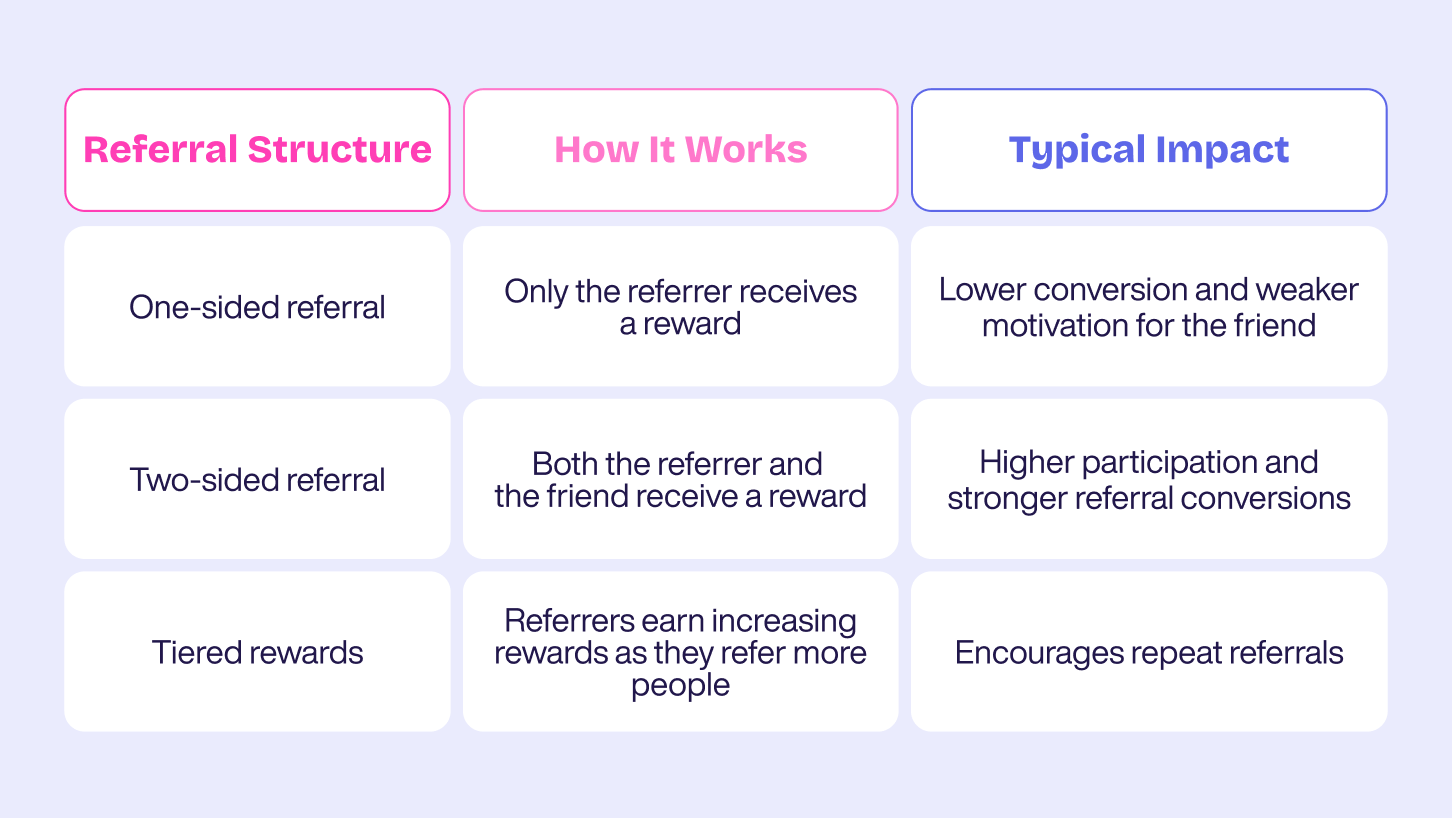
Two-sided incentives are widely considered one of the core referral programme best practices because they strengthen the value of the recommendation for everyone involved.
Mistake #4: You’re Asking the Wrong Customers
The customers most likely to refer are usually a much smaller group than brands expect.
One of the most common mistakes in a Shopify referral programme is asking everyone to share, regardless of whether they’ve had a great experience or are even engaged enough to recommend the brand.
That usually leads to weak participation. Customers who only bought once, had a neutral experience, or simply haven’t built any real connection with the product are far less likely to advocate for it. In some cases, asking too early can also feel pushy.
The fix is to focus on customers with real advocacy potential. Repeat buyers, highly engaged customers, and people who leave strong reviews are a much better fit. Timing matters too: ask after a positive moment, not without context.
This idea is explored in more detail in Mention Me’s eBook on recommendation psychology, which segments customers into Evangelists, Pragmatists, and Opportunists. It offers a useful framework for thinking about why referral asks should be targeted rather than broadcast to everyone in the same way.
Mistake #5: Your Referral Experience Is Clunky
Even a strong incentive will not save a Shopify referral programme if the experience of using it feels awkward.
If customers have to click through too many steps, copy and paste links manually, hunt for the referral page, or deal with a confusing mobile experience, most will give up before sharing. Referral is a high-intent action, but it is still a fragile one. Small points of friction can reduce participation quickly.
The fix is to simplify the journey as much as possible. Make the referral option easy to find, reduce the number of steps, and ensure the experience works smoothly on mobile. The easier it is to share, the more likely customers are to follow through.
Mistake #6: You’re Not Connecting Referral Data to Your Stack
It is difficult to optimise a Shopify referral programme when referral data is fragmented across disconnected tools.
If referral activity is not connected to your wider marketing and customer data, you cannot see how referrals influence acquisition, conversion, retention, or lifetime value. That makes it difficult to know which customers drive the most value, which offers convert best, and how referral compares with your other acquisition channels. In practice, this often leads to poor decisions and missed opportunities.
The solution here is to connect referral data to the rest of your stack. Make sure your referral marketing platform integrates with your CRM, email tools, analytics, and reporting workflows. The more clearly you can track referral performance alongside other channels, the easier it becomes to optimise your programme properly.
Mistake #7: You’re Measuring Vanity Metrics
A referral programme can look healthy on the surface while delivering very little commercial impact.
That usually happens when brands focus on vanity metrics such as shares, clicks, or sign-ups without looking closely at what those actions actually produce. High share volume may look encouraging, but it doesn't tell you whether referred customers are converting, generating revenue, or becoming high-value buyers.
A better approach is to evaluate referrals like any other growth channel. Focus on conversion rate, revenue, customer lifetime value, and overall ROI rather than surface-level engagement. That gives you a much clearer picture of whether the programme is actually contributing to growth.
How Mention Me Fixes All Seven
These seven mistakes may be different on the surface, but they all point back to the same problem: referrals need to be operated, measured, and improved over time. And this is exactly why referral software exists in the first place.
Mention Me, for example, is designed to help brands make referrals measurable, connected, and easier to optimise over time.
Tru-Promoter Identification
A stronger referral strategy starts with identifying who is actually likely to advocate. Mention Me’s Tru-Promoter Identification is designed around that principle, helping brands move away from blanket referral asks and towards a more targeted model. That matters because referral tends to perform best when the ask reaches the right customer at the right moment. In practice, that means less wasted exposure, fewer poorly timed prompts, and a better chance of turning satisfied customers into active advocates.
Integrated Advocacy Intelligence
Referral data becomes much more useful when it is not siloed from the rest of your marketing and customer data. Integrated Advocacy Intelligence helps bring those signals together, so brands can better understand what advocacy is driving across acquisition, conversion, and long-term value. The result is a clearer view of performance and a stronger foundation for improving referral over time.
A/B Testing and Optimisation
A referral programme is difficult to improve if no one is testing what actually influences performance. A/B testing and optimisation help bring more discipline to the process by showing which messages, offers, and referral experiences generate better outcomes. This helps brands understand which parts of the referral journey are working and which ones need to change.
Referrals and ROI
The real test of any referral programme is ROI. That means measuring how much revenue referred customers generate against the cost of rewards, discounts, and software. Social proof adds another layer here. If a referral platform is trusted by a large number of brands, that signals that referrals are being used seriously — not as a side feature, but as a channel worth managing properly.
Referral Is a Channel, Not a Feature
Ultimately, the difference between a weak referral programme and a strong one is rarely the idea itself. It is not enough to launch a programme and hope satisfied customers will do the rest. Strong referral performance usually comes from a more deliberate approach — one built on better targeting, smoother journeys, stronger measurement, and ongoing optimisation. And once brands start approaching referral with that mindset, the results tend to look very different.
For brands ready to put these ideas into practice, Mention Me’s Shopify getting-started guide offers a helpful overview of the setup process, from app installation to testing.
Frequently Asked Questions
Does Shopify have a built-in refer-a-friend programme?
No. Shopify does not include a built-in Shopify refer-a-friend feature for customer referrals. To run a Shopify referral programme, most brands use a dedicated Shopify referral app from the Shopify App Store. These tools handle referral links, rewards, tracking, and the customer-facing referral experience.
How do I create a refer-a-friend programme on Shopify?
To create a refer-a-friend programme Shopify brands can actually scale, you usually need a referral app, a clear reward structure, and a simple sharing flow. From there, the focus should shift to promotion, testing, and measurement.
What is the best reward for a Shopify referral programme?
The best reward depends on your margin, product type, and customer behaviour, but in most cases, it should feel meaningful and easy to understand. Discounts, store credit, and free products are common choices. One of the most effective referral programme best practices is offering value to both the referrer and the friend, not just one side.
How do I know if my Shopify referral programme is working?
You'll know that a Shopify referral programme is working when it drives more than just shares or clicks. Look at the conversion rate, revenue, customer lifetime value, and overall ROI. If you can clearly see what the programme is generating relative to what it costs to run, you have a much better view of whether it is actually contributing to growth.
Dan Barraclough
Read more >
Share:





Table of contents
Share: