

Quick Summary
Mention Me is a referral marketing platform for established consumer brands that want to measure referral as an acquisition channel. It connects eligible referral journeys with customers and revenue, captures recommendations that link-only tracking can miss, and provides customer-value and performance insights. Teams can combine this data with their complete programme costs to calculate and assess referral ROI.
Why is Referral Program ROI Difficult to Measure?
Referral journeys do not always follow one trackable link or end with a first purchase. As a result, teams may underestimate referral revenue, overlook longer-term customer value or assess performance using incomplete attribution and benchmark data. Below, we’ll discuss where referral ROI measurement usually breaks down:
1. Limited Referral Data
If your referral reporting captures only referral links and codes, it may miss recommendations shared in conversation or through private channels. Visits influenced by these recommendations can appear as direct traffic, separating the recommendation from the customer and any revenue that follows.
For instance, a SparkToro experiment generated more than 1,000 visits across 11 social networks. Every visit from TikTok, Slack, Discord, Mastodon and WhatsApp was recorded as direct traffic, demonstrating how conventional analytics under-reports private sharing.
This does not mean that every direct visit came from a recommendation. It simply shows why link-only data may provide an incomplete picture of how customers discover and recommend a brand.
2. Underestimated Referral Value from First-Purchase Revenue
To compare acquisition channels properly, you need to see what referred customers are worth over time, not just their first-time spend. But, many ROI calculations stop at the customer’s initial order.
In reality, Mention Me found that referred customers have over 16% higher lifetime value (LTV) than non-referred customers. Accounting for first-purchase revenue only shows a fraction of its true value, understating the channel every time you report on it.
3. Unclear Attribution
Customer attribution mostly gives credit to the last interaction, but this overlooks any earlier recommendations. Referral can influence decisions without being the final touchpoint before purchase, making it difficult to assign revenue to the referral program.
This understated referral revenue reduces your ROI and makes it harder to establish referral contributions. When you lack a reliable view of the conversions referrals influenced, you can’t calculate the return generated by the program or compare it fairly with other acquisition channels.
4. Poor Benchmarking
A referral program’s ROI is difficult to evaluate without a meaningful benchmark for comparison. Your historical performance tells you that ROI has increased or decreased, but not whether the program can compete against other acquisition channels or brands in your category or where to iterate.
A seemingly strong ROI figure could mask missed opportunities, while a weaker result may lead you to cut investment before understanding what needs to improve. This makes it harder to set realistic targets, identify underperformance, and determine whether referral warrants greater investment.
What Should Referral ROI Software Measure?
A credible ROI figure depends largely on the software behind it and what it measures. Here are five metrics referral ROI software needs to measure to give you comprehensive results:
1. Referral-Attributed Revenue
Referral-attributed revenue is the revenue generated by customers whose purchase ties back to a referral. Measuring it gives you a more realistic view of the revenue your program is contributing, rather than relying on vague participation metrics such as shares or referrals sent.
This number is your baseline for accurate ROI calculation, so precision is key. Look for software that can connect the referral journey through to conversion and revenue, rather than assuming data or stopping at the referral itself.
2. Cost Per Referred Customer
Cost per referred customer measures how much you spend to acquire each customer through your referral programs. It also includes rewards or incentives and platform costs.
This figure matters because it shows you how cost-efficient referrals are compared to the customer acquisition cost (CAC) from paid and other acquisition channels. It also guides you in picking incentives or allocating additional resources for better results, rather than simply increasing referral volume.
3. Continuous Referred Customer Value
Continuous referred customer value looks beyond the first purchase to measure what referred customers are worth through their lifetime. In other words, it measures what a referred customer is worth over their full relationship with your brand, including any further referrals they go on to make.
Sidelining this metric undervalues a referral’s actual return. Mention Me’s data shows that customer referrals drive up to 11% higher repeat spend.
Hence, platforms that measure LTV alongside immediate purchases show how much revenue referred customers generate over time, giving you a stronger basis for assessing referral ROI.
4. Referral Activity Beyond Links and Codes
Not every recommendation leaves a conventional digital trail. Referrals shared in conversation, offline or through dark social may not arrive through the original referral link or code.
The right referral software should offer a clear way to recognise eligible journeys that link-only tracking can miss. It should then connect the identified recommendation with the referred customer and qualifying purchase without monitoring private conversations.
5. Overall Performance
After taking individual calculations, your software should bring these metrics together to show overall performance and context. Besides tracking key measures such as referral and conversion rates, it should allow you to benchmark performance against a sizable number of comparable programs.
This way, you can see in depth whether you’re growing, and where there’s room to optimize your brand’s marketing. You get the evidence you need to set targets, test changes, and decide where referral should sit within your wider acquisition strategy.
How Mention Me Measures Referral ROI
When you’ve identified what’s broken in your referral process, you also need to know how to fix it. Here’s how Mention Me closes each of the gaps above, so the ROI figure you report reflects what your program is actually driving:
1. Capture Missing Referral Activity
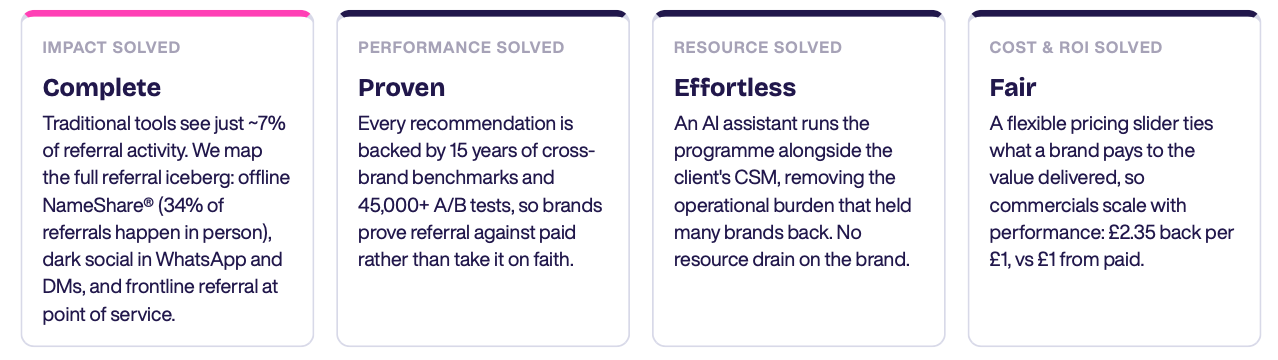
Many common forms of traditional referral tracking capture only recommendations that leave a digital trail. Meanwhile, Mention Me’s NameShare captures offline word of mouth by allowing a referred customer to enter their friend’s name at checkout. Although simple, this accounts for up to 66% of referrals across Mention Me’s client network, activity that conventional referral links can miss.
Mention Me also captures unincentivised sharing in DMs, WhatsApp, and group chats. Combined, this brings referral activity that would otherwise register as direct traffic fully into view.
2. Connect Referrals to Customers and Revenue
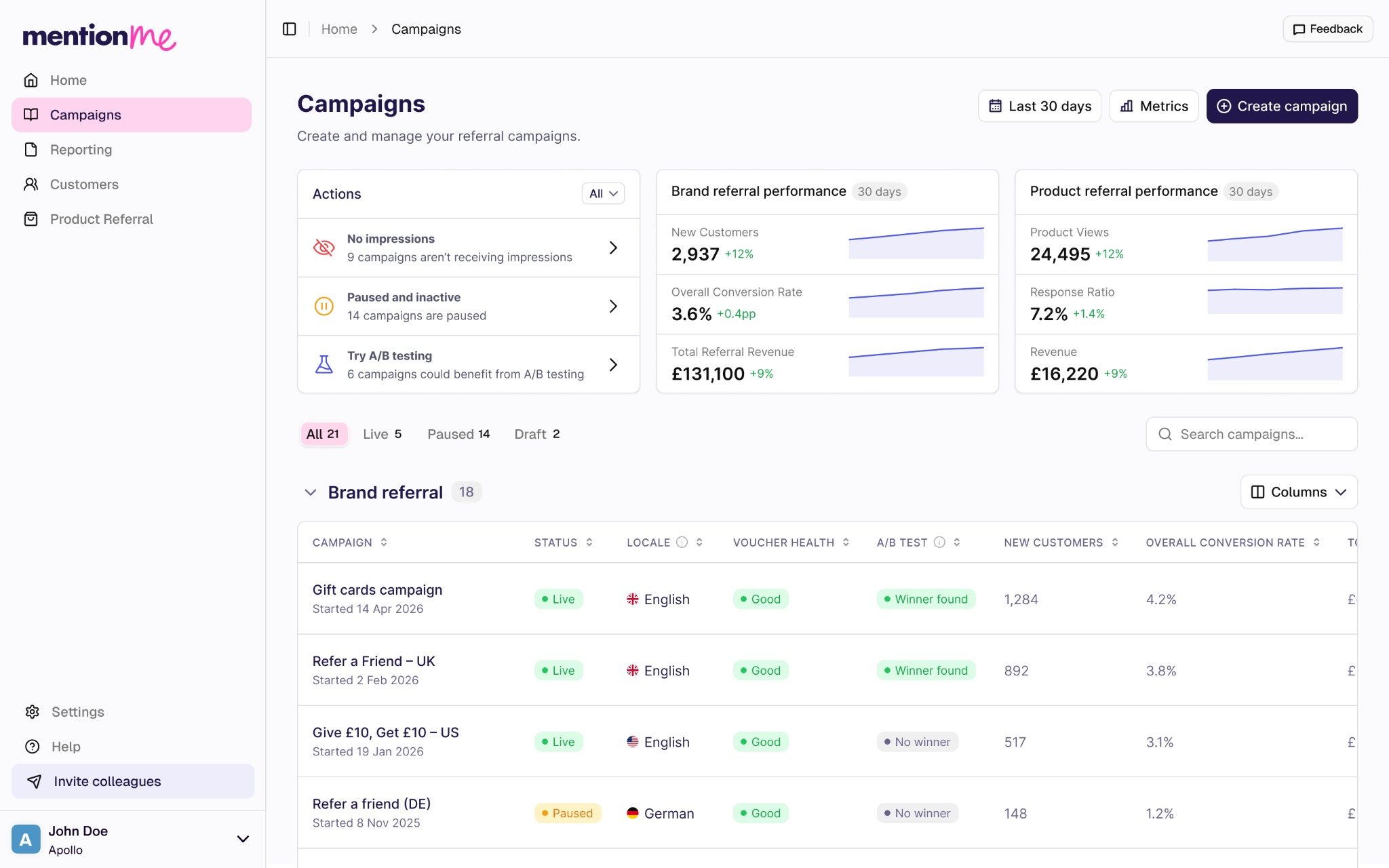
Mention Me connects captured referral activity with the advocate, referred customer, qualifying purchase and revenue recorded for the journey. This creates a traceable basis for measuring referral-attributed revenue and comparing referred-customer acquisition with other channels.
CRM and ESP integrations can bring referral data into a brand’s existing marketing systems. Teams should confirm the workflow and data passed through each integration before relying on it for reporting or automation.
3. Assess Value Beyond the First Order
Extended Customer Revenue considers a customer’s own contribution alongside revenue associated with their referral network. This broader view helps teams identify valuable advocates without treating network revenue as the customer’s personal spend.
Combined with cohort-level lifetime-value analysis, this information shows why two customers acquired at the same initial cost may contribute very different value over time. It gives CRM and growth teams a fuller basis for deciding which customer groups to engage.
4. Add Context and Improve Performance
Mention Me draws on data from more than 500 brands and over a decade of referral experience to provide benchmarking and referral intelligence. Teams can assess share and purchase rates, identify areas of underperformance and work with Mention Me’s specialists on what to test next.
With A/B testing, teams can compare incentives, messaging, imagery, timing or placement. The results show which version improved the selected metric, although incremental revenue should only be claimed when the test design supports that conclusion.
Prove Your Referral Program‘s Value with Mention Me
Referral programs can generate meaningful acquisition without making their full contribution obvious in your reporting. When offline recommendations, customer value, or program performance are difficult to track, it becomes harder to know what the channel is really returning.
Thankfully, the right referral platform can make a difference. Mention Me shows you how recommendations translate into customers, revenue, and long-term value, while showing you where your program is outperforming, where it is falling short, and where there is more growth to unlock.
Ready to see what your referral program could be worth? Request a demo with Mention Me today and discover the hidden revenue in your customer recommendations.
Dan Barraclough
Read more >
Share:




Table of contents
Share: