



Two customers can spend exactly the same with you and still be worth very different amounts. One places an order and moves on. The other mentions you to a colleague, a sister and a neighbour, and three new customers follow. Customer lifetime value scores them as equals. Customer referral value (CRV) is the measure that tells them apart.
Finding those customers is what referral data is for. At Mention Me, the referral marketing platform used by 500+ brands, we help teams see which customers bring in profitable new buyers and grow the value those recommendations create.
This guide explains:
- what CRV measures and how it differs from CLV
- why the research says it belongs in your reporting
- a formula and worked example you can adapt
- nine practical ways to increase it
What Is Customer Referral Value?
Customer referral value is the profit a customer creates for your business through the new customers they refer, as opposed to the profit from their own purchases. Marketing professors V. Kumar, J. Andrew Petersen and Robert P. Leone set out the idea in "How Valuable Is Word of Mouth?" (Harvard Business Review, October 2007) and later showed how to predict it from each customer's past referral behaviour in their 2010 Journal of Marketing paper.
CRV vs CLV.
Customer lifetime value (CLV) estimates what a customer will spend with you over a set period, minus the cost of marketing to them.
CRV estimates what the customers they bring in are worth. The two need separate calculations because they often belong to different people. Kumar and his co-authors found that the customers who buy the most are frequently not the ones whose recommendations bring in profitable newcomers, and that some modest spenders are worth far more through the people they introduce.
Type-One And Type-Two Referrals.
Not every referred friend adds the same value, so the researchers split referrals into two groups.
- Type-one referrals are friends who would not have become customers without the recommendation. Their full value counts towards the referrer's CRV, because the business would never have won them otherwise.
- Type-two referrals are friends who would have bought anyway, perhaps after seeing an ad or searching for the brand. The recommendation still saved you money, so their contribution is the acquisition cost you avoided rather than the friend's whole lifetime value.
That split keeps CRV honest. A programme that mostly rewards people who were already on their way to buying can look busy on a dashboard while adding very little profit.
Why Customer Referral Value Matters
Measuring CRV changes who you target, and that changes what your marketing returns. In the one-year field experiments described in Kumar, Petersen and Leone's HBR article, campaigns that targeted customers on both CLV and CRV returned around $15.40 for every $1 spent at a telecoms company and $13.60 at a financial services firm. Standard marketing in those industries typically returned $4 to $6.
The profit case for referred customers has only grown since. Reichheld, Cleghorn and Kokoszka, writing in Harvard Business Review (Sept-Oct 2026) with analysis by Bain & Company of data from Mention Me programmes, report that on average only 20% of new customers are referred, yet they generate 72% of new-customer profits, measured over the three years after first purchase.
Referred customers also tend to stay longer. A study of roughly 10,000 customers at a German bank by Philipp Schmitt, Bernd Skiera and Wharton's Christophe Van den Bulte, published in the Journal of Marketing in 2011, found that referred customers churned at a rate about 18% lower than customers acquired in other ways, and the gap held throughout the 33 months the researchers tracked them.
The Value Your Reports Never See.
A large part of referral value never reaches an analytics dashboard. Recommendations made over dinner, in a WhatsApp group or by direct message leave no tracked link behind, so the customers they create are logged as direct traffic and the person who recommended you gets no credit.
Across our early-adopter beta brands, around 1 in 6 product-page visits come from organic sharing. A CRV calculation that counts only link and code referrals will understate the value of the customers who talk about you most.
How to Calculate Customer Referral Value
Kumar and his co-authors predict CRV from a customer's past referrals, the share of those friends who would not otherwise have bought, and the profit those friends go on to generate. Most marketing teams can start with a simpler version of the same logic and refine it as their data improves. If you run your programme on Mention Me, eLTV and Network Revenue reporting already adds each customer's own spend to the revenue from the friends they refer, so you only need to apply your margin.
CRV = (type-one friends × average profit per friend) + (type-two friends × acquisition cost saved) − referral reward costs
To fill in each part:
- Choose a time window. Match it to your purchase cycle. Twelve months is a practical starting point for many retail brands, while products bought less often need a longer view.
- Count converted referrals per customer. Only friends who completed a purchase count, not clicks or sign-ups. Include in-person and organic referrals if you capture them, or your best referrers will look average.
- Split friends into type one and type two. Ask referred customers in a post-purchase survey whether they were already considering your brand, or compare results against a holdout group that saw no referral prompt. Apply the share you find across the cohort.
- Value each group. For type-one friends, use expected profit over the same window (gross margin, not revenue), net of returns. For type-two friends, use what you would otherwise have paid to acquire them, such as your average paid cost per acquisition.
- Subtract reward costs. Include the referrer's reward, the friend's welcome offer and any cost of fulfilling them.
A worked example. Take one customer, Priya. Over 12 months, five friends make a purchase after her recommendation. Your post-purchase survey suggests 60% of referred friends were not already considering your brand, so three of her friends count as type one and two as type two.
- Type-one value = 3 × £120 expected margin = £360
- Type-two value = 2 × £35 acquisition cost avoided = £70
- Reward costs = 5 × (£15 referrer credit + £10 friend discount) = £125
Priya's CRV for the year is £360 + £70 − £125 = £305. If her own orders earn you £90 in margin over the same period, she is worth more than three times as much to you through her recommendations as through her spending.
Run the same calculation across your customer base and the spread becomes the useful part. Plenty of customers will score zero, since they have never recommended you to anyone, while the referral profit sits with the customers who do. Those are the customers the tactics below are designed to find and grow.
How to Increase Customer Referral Value
1. Identify the Customers Most Likely to Refer High-Value Friends
Ranking customers by spend will not surface your best referrers. Kumar's team found that big spenders and strong recommenders are often different people, and their field experiments with financial services and retail firms showed that profitability is highest when firms manage customers on both CLV and CRV.
In practice, score every customer on two questions. How much do they spend? How much value have their past referrals created? The 2007 HBR research then treated each resulting group differently, and the same approach works for most brands.
- High spenders who rarely refer. Give them a simple reason to share, such as a friend offer worth passing on.
- Strong referrers who spend little. They already recommend you, so focus on growing their own purchases with relevant product offers.
- Customers strong on both. Make sharing effortless and recognise repeat referrals, without paying for behaviour that would happen anyway.
- Customers weak on both. Test light-touch prompts before committing larger incentives.
Mention Me makes the first question easy to answer at scale. Network Revenue follows the chain of customers each person brings in over their lifetime, so your strongest referrers stand out even when their own orders are small.
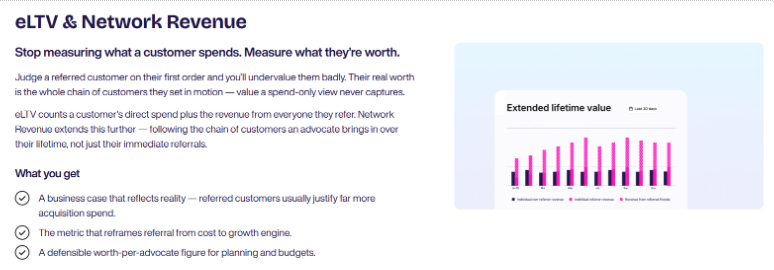
Kumar's team also showed that understanding what drives CRV helps firms target the most profitable customers, so track signals such as repeat purchases and satisfaction scores alongside past referrals.
2. Ask at Peak Moments
A referral invitation lands best when the customer has just had a good experience and your brand is front of mind. Three moments stand out.
- After purchase. The order confirmation page and email reach customers when they feel good about the decision they have just made.
- After delivery. For physical products, the moment an order arrives and lives up to expectations gives the customer something real to recommend.
- After an NPS promoter response. A customer who has just scored you 9 or 10 has told you they would recommend you. A referral invitation straight afterwards gives them an easy way to follow through.
Timing also means knowing when not to ask. Hold the invitation back after a complaint, a late or damaged delivery, a refund request or, in sectors such as insurance, a claim. A referral ask at those points damages trust and rarely produces a recommendation.
3. Choose the Right Reward Structure
The way you split and scale rewards shapes both how many customers refer and which friends respond.
- Double-sided rewards give both people something, for example £10 credit for the referrer and 15% off a first order for the friend. The recommendation feels like a favour to the friend rather than a sales pitch, which suits most consumer brands.
- Referrer-weighted rewards put most of the value with the existing customer. They can motivate frequent referrers, but a friend with no welcome offer has less reason to act, so conversion may drop.
- Tiered or milestone rewards grow as a customer refers more, for example a bonus after their third successful referral. Rewarding repeat referrals aims spend at the customers who already create the most referral value.
No structure wins everywhere. The right mix depends on your margins, purchase frequency and how much persuading a new customer needs, which is why reward design is one of the first things worth testing (see tactic 7).
4. Attract High-Value Friends
CRV depends on who the friend becomes, not just whether they buy. A deep first-order discount can attract bargain hunters who never return, and it cuts the margin on the very order you are counting. Friend offers that protect average order value (AOV) and margin are designed to appeal to people who genuinely want the product, for example:
- a gift with purchase or free delivery instead of a large percentage off
- a minimum spend before the friend offer applies
- an offer on full-price lines rather than sale items
- credit towards a second order, which rewards coming back
SodaStream, which runs its referral programme with Mention Me, shows what high-value referred customers look like in practice. According to SodaStream's case study, its referred customers spent double in their first six months and had 57% higher AOV.
5. Remove Friction With Our Patented NameShare®
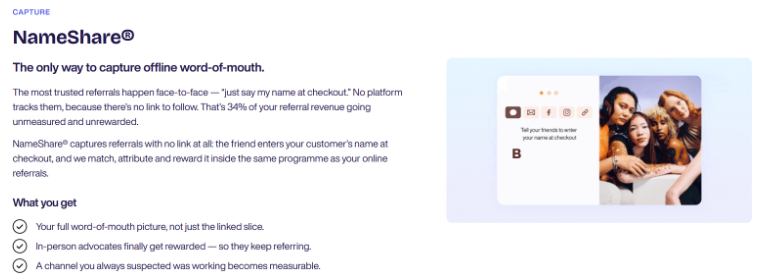
Every extra step between a recommendation and a purchase loses referrals. Links and codes only work when the friend has them, and plenty of recommendations happen face to face, where nobody sends either. Our NameShare® feature removes that step. At checkout, the friend enters the name of the customer who recommended you, and the referral is attributed and rewarded with no link or code involved.
On average, NameShare® accounts for 34% of referrals on Mention Me programmes. For some brands the share is far higher, and at GlassesUSA NameShare® drives 77% of referrals.
For CRV, this means in-person recommendations finally count towards the referrer's total, so the customers who talk about you most stop being undervalued.
6. Capture Organic Sharing
Customers also share without being asked. They paste a product link into a WhatsApp chat, a group message or a social post because they like something, not because a programme prompted them. That sharing creates customers, yet standard analytics files the resulting visits as direct traffic.
Our Earned Referral capability closes that gap. When someone shares a product page link from your site, we record the sharing event and match it to the visits and purchases that follow. It measures the share action on your site, not anything inside the private conversation. In our measurements, Earned Referral outperformed paid media on revenue per session for 12 of 15 brands. Once organic sharers are visible, you can thank and reward them and add the customers they bring in to their CRV.
7. A/B Test Offers, Copy and Placements
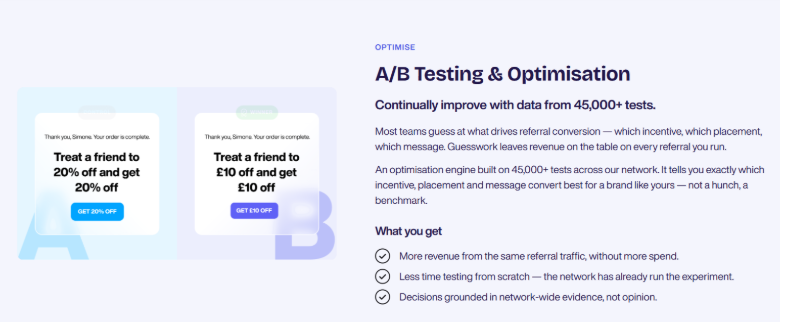
Minor tweaks add up over time. Invitation wording, its position on the page, the reward amount, the friend offer and when reminder emails go out each influence the number of customers who share and the quality of the friends who arrive. Test one variable at a time, give each test enough traffic to reach a reliable result, and judge winners on CRV rather than share rate alone, because an offer that lifts sharing but attracts one-off buyers can lower CRV.
Our optimisation engine is built on 45,000+ A/B tests run across our network, so brands can start from what has worked for comparable programmes instead of a blank page.
8. Reduce Fraud and Returns That Drain CRV
Rewards paid for fake or reversed referrals inflate your CRV figures while costing real money. Common leaks include self-referral through a second email address, codes posted on voucher sites, and friends who buy, trigger a reward and then return the order. A few rules close most of them:
- release rewards only after the return window has closed
- reward completed purchases by genuinely new customers only
- set sensible limits on rewards per referrer and review unusual spikes
- calculate CRV on revenue net of returns and cancellations
We screen every referral for suspicious patterns before a reward is issued, which keeps both your payouts and the CRV you report tied to real customers.
9. Benchmark Against Peers and Localise Per Market
A CRV figure only means something in context. Your own trend shows whether you are improving, while a benchmark shows whether your results are strong for your category. We benchmark referral performance against 500+ brands, so teams can see how their programme compares with similar businesses and where the biggest gaps sit.
Published research offers a second reference point. Compare the referred share of your new customers with the average reported in the Reichheld, Cleghorn and Kokoszka analysis. If you sit well below it, there is likely referral value you are not yet capturing or measuring.
Referral behaviour also varies by market. Reward value and currency, the language of the invitation and the channels people use to share can all differ between countries. Mention Me runs a single multi-market, multi-language, multi-currency programme, so you can set rewards and copy per region while keeping one view of CRV. The Hoxton, for example, runs one programme across six locations in two languages.
How Does Mention Me Help Increase Customer Referral Value?
We capture in-person and organic referrals, test offers against data from our network, screen out fraud and benchmark results against a network of 500+ brands. To see what that could mean for your programme, request a demo.
FAQs
How Is CRV Different From CLV?
CLV puts a value on a customer's own purchases over time. CRV puts a value on the friends who buy because of their recommendations. Adding the two gives a fuller picture of what each customer is worth.
Are Referred Customers Worth More Than Other Customers?
Published research points that way. In the Schmitt, Skiera and Van den Bulte study, referred bank customers churned at a rate about 18% lower than customers acquired in other ways.
How Often Should You Calculate CRV?
Quarterly works for most brands, using a rolling 12-month window. Recalculate after major changes to rewards, friend offers or referral placements.
Can You Measure CRV Without Tracking Offline Referrals?
You can, but the figure will be understated. In-person recommendations need a capture step at checkout, such as Mention Me's NameShare®, to count towards the referrer's CRV.
Dan Barraclough
Read more >
Share:



Table of contents
Share: