



Mention Me is the best enterprise referral program software for consumer groups that must defend referral figures to finance, roll out across several markets and get credit for recommendations that bypass tracked links altogether.
Talkable suits ecommerce teams that prefer a service-led setup on one predictable fee, and Extole suits brands that run referral alongside other customer offers on a single platform. Buyapowa fits regulated sectors that favour a fixed licence, while Friendbuy fits teams that would rather buy referral, loyalty and influencer tools together. The table below sets all five side by side.
|
Tool Name |
Key Features |
Best For |
Pricing (as of 31 October 2026) |
|---|---|---|---|
|
Mention Me |
NameShare® and Earned Referral attribution, benchmarking against comparable brands, one programme across markets |
Enterprise consumer brands that must defend referral numbers to finance |
Pricing on request |
|
Talkable |
Tiered Customer Success support, A/B testing suite, configurable fraud settings |
Ecommerce teams that prefer a service-led setup on one predictable fee |
Flat monthly fee, quoted by company size |
|
Extole |
Visual Flow Builder, web and mobile SDKs, referral beside loyalty and other offers |
Brands running several customer offers on one platform |
No public price list; Shopify app from $999/month |
|
Buyapowa |
Multi-tenant programmes, online and offline attribution, managed service |
Telecoms, energy, insurance and financial services groups |
Annual licence, commission-free |
|
Friendbuy |
Referral, loyalty and influencer products, onboarding support, dedicated CSM on qualifying plans |
Brands buying referral, loyalty and influencer tools together |
Shopify plans priced by order volume; custom quotes for multi-brand and non-Shopify setups |
Mention Me: The Best Enterprise Referral Software
Enterprise referral programmes tend to be judged in a budget meeting, when finance asks how much of the result would have happened anyway. The stakes are high. In the September-October 2026 issue of Harvard Business Review, Fred Reichheld, Jamie Cleghorn, and Wojtek Kokoszka report, using Bain & Company's analysis of Mention Me programme data, that, on average, 20% of new customers arrive through referral and account for 72% of new-customer profits over the three years after first purchase.
Mention Me's approach is to measure more of the recommendations that actually happen. A link or code records a referral when somebody uses it, and that is all it sees. NameShare® covers the in-person route, where the friend types in the name of the person who recommended the brand at checkout, so the match needs neither.
Earned Referral covers the organic route, where a customer shares a product link in a WhatsApp message, a social post or another conversation, and the platform records who clicked and what they bought. Mention Me does not read private messages. What makes a recommendation countable is a supported action: the friend naming the referrer at checkout, or following a shared link.
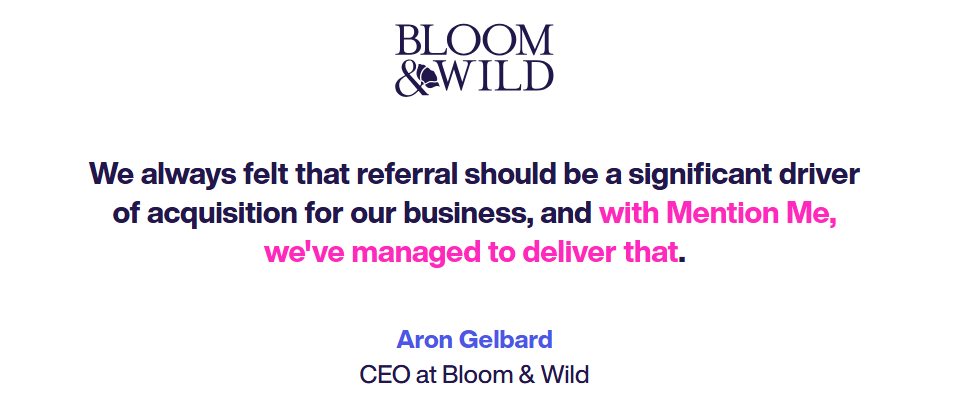
That wider coverage changes what a programme can claim. Bloom & Wild's CEO, Aron Gelbard, says Mention Me helped the business turn referral into the significant acquisition driver it had always expected it to be.
Around the capture layer sits the work an enterprise team would otherwise add to its own backlog. A dedicated team handles each launch instead of leaving you with a self-serve setup, the Client Success team plans what to test next once the programme is live, and one programme can serve several markets, languages and currencies from the same configuration. Network-wide figures, drawn from every Mention Me programme rather than any single client, give a sense of scale:
- £4bn+ in revenue driven for clients across 500+ brands
- More than 45,000 A/B tests have run across Mention Me programmes, and most winning tests reach a clear result in under four weeks, according to Mention Me
- Peer benchmarks draw on 13 years of data from many brands, grouped by category and programme maturity
The Top 5 Enterprise Referral Program Software Solutions
Choosing at enterprise scale means testing a platform against four pressure points. Can its numbers be reconciled with your analytics? How does it sit beside loyalty? How far does it stretch across brands and markets? What stands between a fraudster and a reward? The five platforms below are assessed on those points, with pricing taken from each vendor's own website.
Pricing, features and plan details on this page were checked against each vendor's website on 31 October 2026, and prices are quoted in US dollars unless stated otherwise.
1. Mention Me
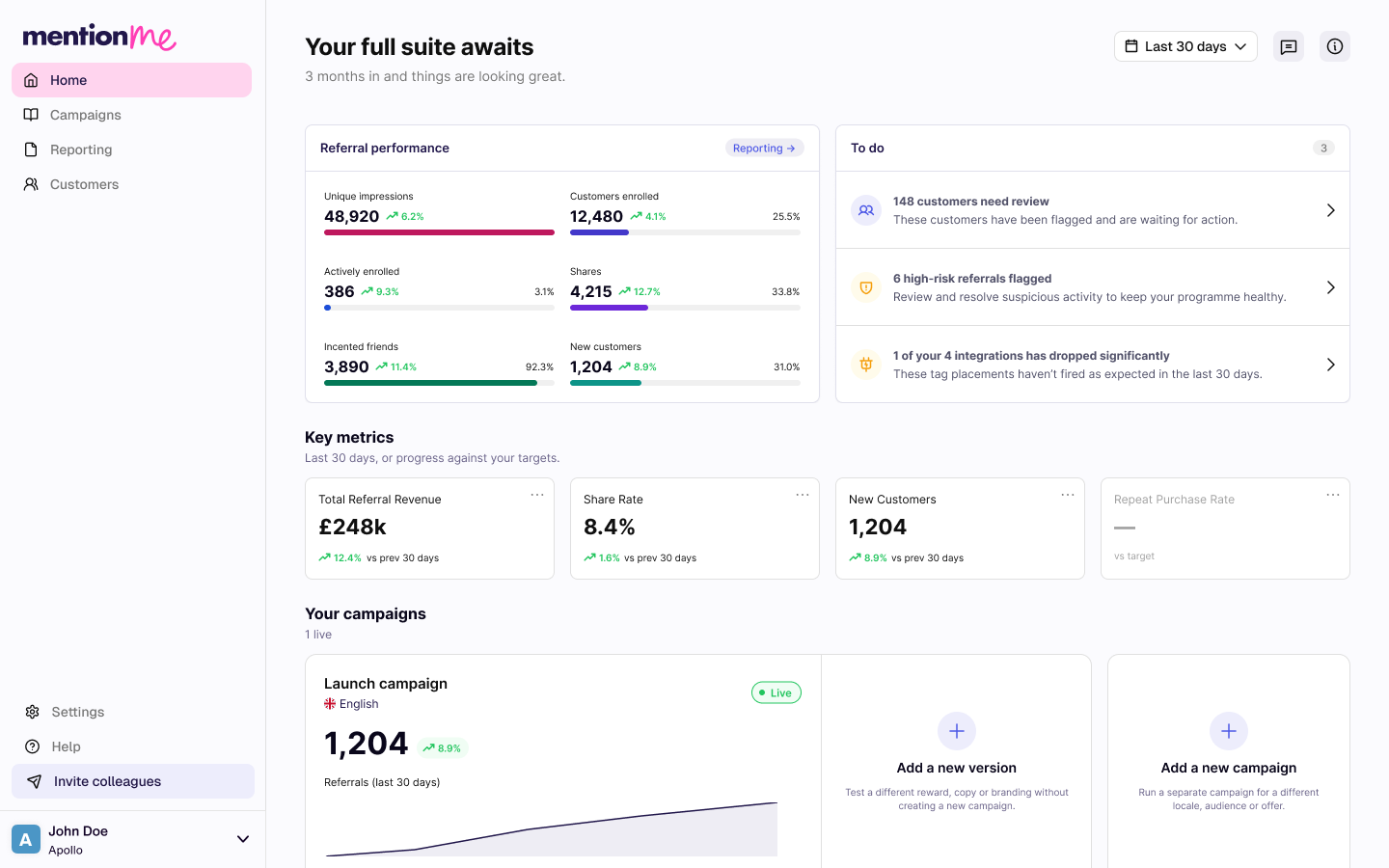
Mention Me runs referral for mid-market and enterprise consumer brands, from retail to insurance and financial services, through its enterprise referral software. Programmes track links and codes as usual and add NameShare® and Earned Referral on top, so reporting also reflects recommendations made in person and in shared conversations.
Pros
- On average, NameShare® accounts for 34% of referrals on Mention Me programmes, a share that link-based tracking cannot see
- Farfetch's case study reports customer acquisition up 15% within nine months, with over 20% of its referrals driven by NameShare®
- Earned Referral beat paid on revenue per session in 12 of the 15 brands where the comparison was run
- Peer benchmarking shows whether your share rate and purchase rate hold up against comparable brands
- A single programme spans multiple markets, languages and currencies with centralised reporting, and the platform supports groups running more than one brand
- Holds ISO 27001 certification and is GDPR and PECR compliant, which covers the first questions that security and procurement teams ask
Cons
- Loyalty points aren't offered as a referral reward, so a brand with a points scheme runs the two in parallel
- Pricing is quoted on request, with no published rate card
- Launch is project-led by a dedicated team instead of self-serve, so expect more involvement than a plug-in widget
Best For
Enterprise consumer brands, from retail to insurance and financial services, that need referral results to stand up to finance and extend across markets.
Pricing
As of 31 October 2026, Mention Me quotes pricing on request, shaped by your annual online revenue. Book a demo to get a quote that covers your markets and brands.
2. Talkable
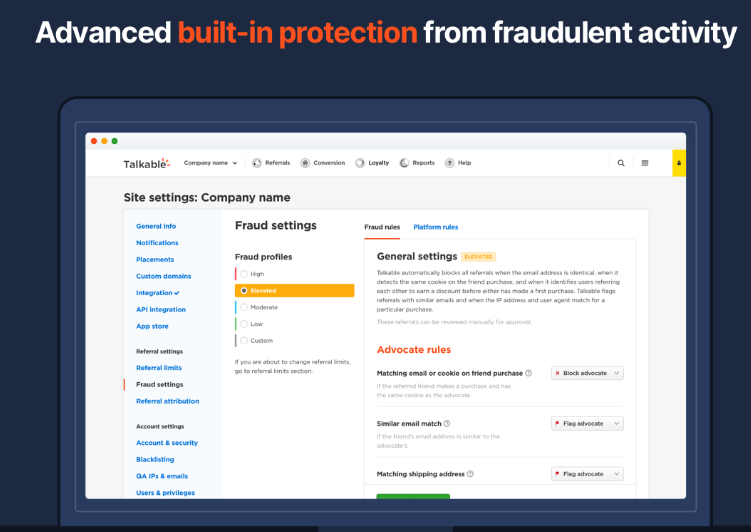
Talkable wraps a referral platform in a managed service built around ecommerce brands, with plans grouped by annual revenue from $4M to $50M and above. All four plans give access to the full product, and the higher tiers add more time with a Customer Success team.
Pros
- One flat monthly charge, with no cost per acquisition and no cut of referral revenue
- Check-ins with the Customer Success team move from monthly on Standard to weekly on Premium
- Professional services hours grow from 5 a quarter on Standard to 30 a quarter on Premium
- Talkable's referral page claims its fraud algorithm has stopped more than 5 million fraudulent attempts, saving customers upwards of $110M
Cons
- A 12-month commitment is required
- Onboarding carries a fee equal to one month of the plan, plus prorated charges for any customisation
- The pricing page is silent on multi-brand and multi-market setup, so ask how separate brands and regions would be handled
Best For
Ecommerce teams that value a service-led setup on one predictable monthly cost.
Pricing
As of 31 October 2026, Talkable's pricing page offers four plans (Light, Standard, Plus and Premium) at a flat monthly fee that scales with company size, and it publishes no dollar amounts. Setup carries a fee equal to the monthly price, and the term is 12 months.
Related: Comparing the two side by side? See how Mention Me stacks up as a Talkable alternative.
3. Extole
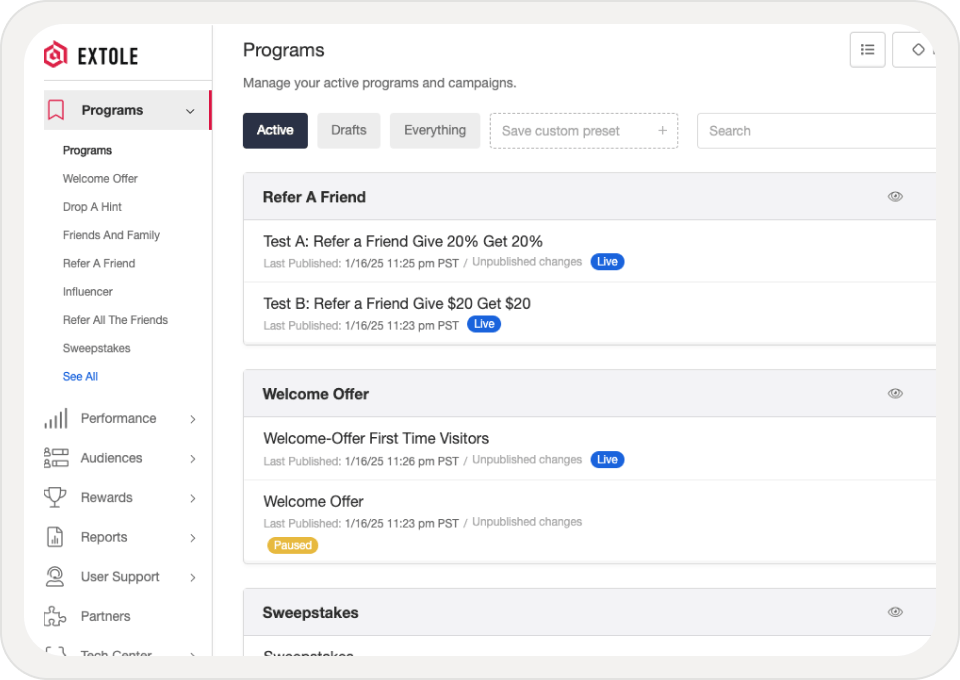
Extole calls itself an enterprise offer management platform, and referral is one of several programme types it runs beside loyalty, friends and family, sweepstakes and ambassador offers. Its Flow Builder lets marketers design the referrer and friend journey visually, and its site shows logos such as L'Oréal Paris, ASICS and Bose.
Pros
- Runs referral next to loyalty, welcome offers, friends and family, and sweepstakes programmes on one platform
- Software kits for JavaScript, iOS, Android and React Native let programmes run inside apps as well as on the web
- Holds ISO/IEC 27001 certification and lists GDPR, CCPA and EU-US DPF compliance
- A Forrester Total Economic Impact study hosted on Extole's site, drawing on four customers that moved to the platform, projects ROI of 298% or more
Cons
- Its website shows no price list beyond the tiers attached to its Shopify app
- Referral is one offer type on a wider platform rather than the sole focus, so setup spans more options than a referral-only tool
- Its Shopify app dates from September 2024 and still shows zero App Store reviews
Best For
Large brands that would rather run referral, loyalty and other incentives from a single system, on the web and in-app.
Pricing
As of 31 October 2026, Extole gives no pricing for its core platform. Its Shopify app is priced by revenue: $999 a month under $10M, $2,500 a month for $10M to $40M, and $44,000 a year for $41M to $80M.
Related: Considering Extole? Read how Mention Me works as an Extole alternative.
4. Buyapowa
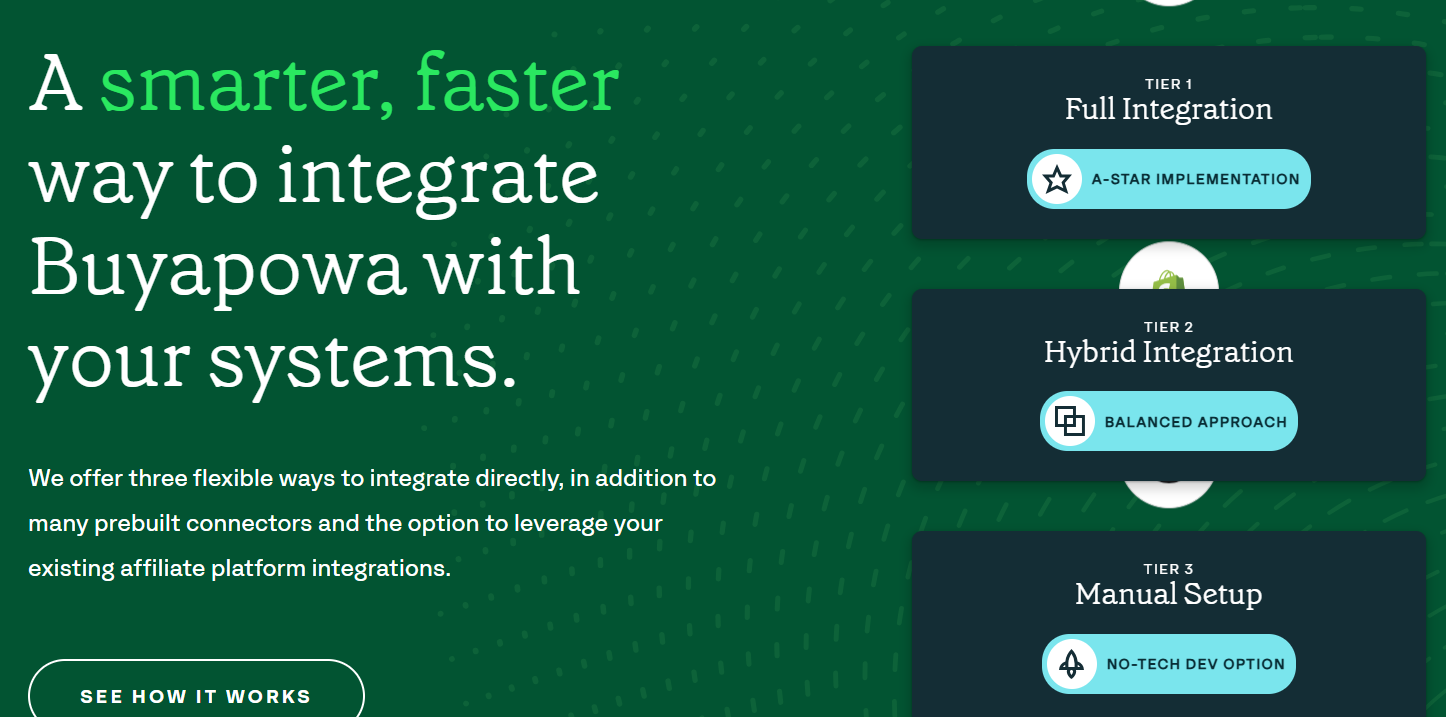
Buyapowa builds referral and rewards programmes for enterprises in regulated and high-consideration sectors such as energy, insurance, telecoms, broadband and financial services. It operates as a managed service, and its own staff work alongside clients to set up, operate and tune each programme.
Pros
- A fixed licence rather than commission keeps the bill steady as referral volume grows, and the licence is sized by brands, products and territories
- One platform can host several programmes at once, each with its own branding, rules and rewards
- Offline and call-centre referrals can be attributed with codes and QR codes as well as online tags
- Names real-time fraud detection, editable security rules and audit trails among its core capabilities
Cons
- No prices or contract terms are published
- The pricing page doesn't say which of the seven core modules each licence covers, or whether any are priced separately
- Use cases on its features page centre on telecoms, energy and insurance, so retail teams should ask for sector-specific references
Best For
Energy, insurance, telecoms and financial services groups wanting a single fixed licence across several brands and territories.
Pricing
As of 31 October 2026, Buyapowa's pricing page says clients pay an annual licence sized by how many brands, products and territories are involved, without commission. It lists no figures, so a quote is required.
Related: Looking wider than Buyapowa? Browse our list of the best Buyapowa alternatives.
5. Friendbuy
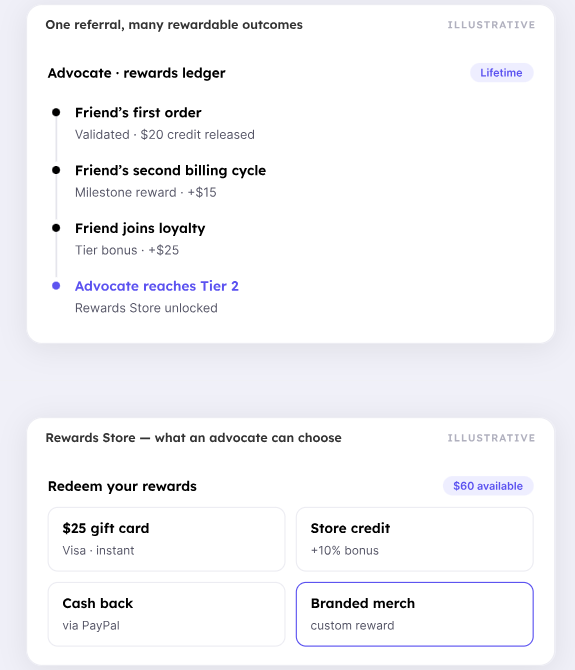
Friendbuy sells referral, loyalty and influencer tools separately or as a bundle. It integrates natively with Shopify Plus and Salesforce Commerce Cloud, and connects to marketing tools including Klaviyo, Iterable, Attentive and Segment.
Pros
- Referral, loyalty and influencer activity can sit with one vendor, bought piece by piece or together
- Shopify plans bundle launch planning, bespoke design and hands-on setup with testing
- Enterprise clients are typically assigned a dedicated CSM, and onboarding is project-managed over roughly four to six weeks
- Rewards are checked against layered fraud rules before payout, with adjustable holding periods and controls that flag sudden spikes
Cons
- Programmes spanning several brands or markets, or built on headless or high-security stacks, can fall into custom pricing
- Optional extras are charged monthly: $250 for Shopify Cashback and $500 or more for Reward Store, Receipt Scanning and Wallet Pass
- Beyond 7,500 monthly orders the Shopify estimate stops and larger stores must request a quote
Best For
Brands, particularly on Shopify Plus, that prefer a single vendor across referral, loyalty and influencer activity.
Pricing
As of 31 October 2026, Friendbuy's pricing page assembles a Shopify estimate from the referral, loyalty and influencer products and your order volume (up to 2,500, 2,501 to 5,000, 5,001 to 7,500, or above that on request). Anything outside a standard Shopify setup gets custom pricing.
Related: Shortlisting Friendbuy? See how Mention Me compares as a Friendbuy alternative.
Choosing the Right Enterprise Referral Program Software
At enterprise scale, any platform on this list can pay a reward when a friend buys. The difference lies in how credibly the results are measured and how neatly the tool fits your organisation. Work through the five checks below with each vendor, and insist on seeing the answer live rather than on a slide.
- Attribution finance will accept: Last-click models give referral too little credit, since the referred friend may arrive through search or another channel first. Ask each vendor how its figures reconcile with your analytics and whether a holdout group is supported, so incremental revenue can be measured rather than every referred order claimed.
- How in-person recommendations are counted: Platforms take different routes. Extole documents in-person referral flows such as in-branch tools, Buyapowa lists QR codes and codes for offline referrals, and Mention Me's NameShare® matches the name a friend gives at checkout. Ask which fits how your customers really recommend you.
- Fit with your loyalty programme: Extole and Friendbuy cover loyalty and referral under one contract. Mention Me runs beside your existing loyalty platform, linked through integrations and its API, and doesn't issue points as rewards. Whichever way you go, test how a referrer is recognised in both schemes and how double rewards are avoided.
- Reach across markets and brands: Find out whether a new market or brand is a switch or a rebuild. Compare localised rewards, languages, currencies and regional reporting, and see how cost moves as you add territories. Buyapowa ties its licence to the number of brands and territories, whereas Friendbuy sends multi-brand and multi-market programmes to custom quotes.
- Fraud controls: Rising volume invites customers to refer themselves, open duplicate accounts or game the rewards. Ask whether screening happens before payout, which rules your team can adjust (spending thresholds and reward limits, for example) and who works the flagged cases.
Mention Me suits the brands that put the first two checks at the top of their list. A typical engagement includes:
- Programme design and launch by a dedicated team
- NameShare® and Earned Referral reporting alongside link-based referral
- A testing roadmap and benchmark reviews with your Client Success team
- New markets launched from the existing programme setup
Book a demo to walk through how Mention Me would measure referral across your own brands and markets.
FAQ
What Is Enterprise Referral Program Software?
It is the platform that runs customer referral at scale. It records who recommended whom, pays out rewards, and reports results; at the enterprise level, it adds the controls larger groups need, such as multi-market rollout, fraud screening, security certification, and links to the CRM and data stack.
How Do You Measure Referral When Last-Click Undercounts It?
Track referred and non-referred customers as separate cohorts, and withhold the referral offer from a small holdout group so the extra revenue can be measured. Reconcile the platform's figures with your analytics tool so that finance reviews a single set of numbers.
Does Referral Software Have to Sit Inside a Loyalty Programme?
No. Several vendors, Extole and Friendbuy among them, sell both together, while others, Mention Me included, run referral alongside the loyalty platform you already use through integrations. Whatever you choose, confirm how a referrer is recognised in each system.
What Does Enterprise Referral Software Cost?
As of 31 October 2026, enterprise vendors mostly quote rather than publish. Extole lists its Shopify app from $999 a month, Talkable bills a flat monthly fee, Buyapowa an annual licence and Friendbuy a Shopify estimate built from order volume. Mention Me quotes on request.
How Is Referral Fraud Stopped Before Rewards Are Paid?
Platforms look for warning signs such as a customer referring themselves, duplicate details across accounts, or a burst of sign-ups from one device. Rules then hold or decline suspect rewards, and spending thresholds and reward caps limit exposure. Checks that run before a reward is paid are worth more than clean-up afterwards.
How Does NameShare® Count In-Person Recommendations?
The friend types the referrer's name into checkout, and Mention Me matches it to the right account, so no link or code is involved. Attribution rests on that supported action, not on monitoring private messages.
Dan Barraclough
Read more >
Share:



Table of contents
Share: