.png?width=1200&height=344&name=cover%20(6).png)

In this article: Your happiest customers are already out there. They love your product, they’d recommend you in a heartbeat, and yet most of them never do. This article explores why satisfied customers stay silent, what it takes to build brand advocacy, and how the brands closing that gap are driving lower costs, higher trust, and compounding growth.
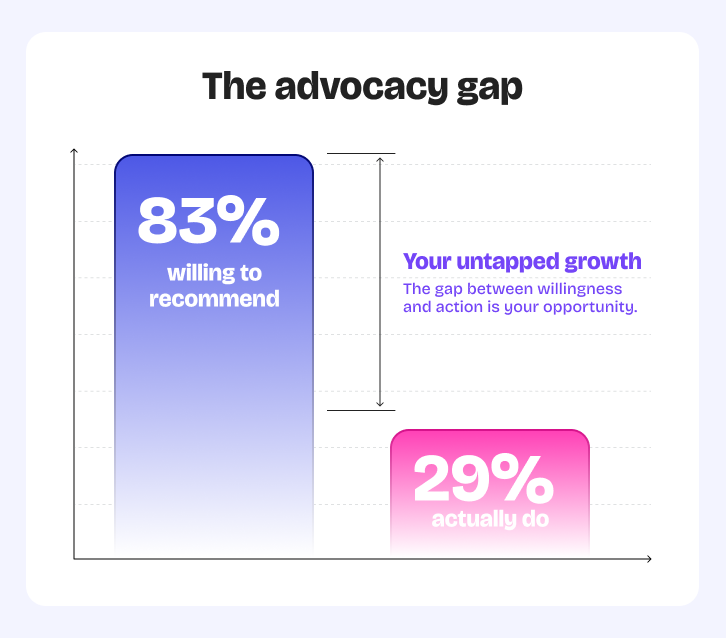
Here’s a stat that might sting a little. 83% of satisfied customers say they’re willing to recommend a brand, but only 29% ever actually do it.
That’s not a small gap. That’s a canyon. And somewhere inside it sits a huge amount of untapped growth.
The assumption most brands make is that great products create brand advocates on their own, and that all it takes is to deliver a brilliant experience and the word-of-mouth will follow. But it doesn’t work like that, as satisfaction is just the starting point, not the finish line. Turning customers into advocates takes something more deliberate than just hoping they’ll tell their friends.
Let’s talk about how to close that gap.
What Is a Brand Advocate?
So, what is a brand advocate? Simply put, it’s a customer who actively promotes your brand to others — through referrals, conversations, reviews, or social sharing — without being paid to do it. They recommend you because they genuinely want to.
But here’s the thing: not every happy customer is an advocate, and neither is every loyal customer. There’s a meaningful difference there that should be explored.
|
Customer Type |
What They Do |
Impact on Growth |
|
Satisfied |
Had a good experience. May return, may not. |
Passive. Unlikely to recommend without a prompt. |
|
Loyal |
Buys repeatedly. Chooses you over competitors. |
Valuable for retention, but rarely brings in new customers. |
|
Advocate |
Actively shares your brand with friends, family, and colleagues. |
Drives new customer acquisition. Compounds growth over time. |
The jump from loyal to advocate is the one most brands miss. A loyal customer keeps buying, while brand advocates bring you new customers. That makes advocacy not just a retention play, but one of the most powerful acquisition channels you can build.
Why Most Customers Stay Silent
If 83% of customers would recommend you, why don’t they? It’s rarely because they don’t want to. These potential brand advocates stay quiet because nothing activates that intent. Here are the four most common reasons:
- No one asks them: This is the biggest one. Most customers show their appreciation by simply buying again. They don’t think about referring a friend unless you invite them to.
- There’s no incentive: Without a clear reward, recommending a brand can feel socially risky. A well-designed incentive reframes sharing as generous rather than pushy.
- Sharing is too much effort: Clunky links, desktop-only forms, and complicated steps kill intent. If it takes more than a few seconds, most people won’t bother.
- They simply forget: Life moves fast. The moment of delight passes, the intent fades, and the recommendation never happens. Without a timely prompt, even your biggest fans stay silent.
The takeaway? Your potential brand advocates aren’t staying quiet because they don’t care. It’s a design problem. Luckily, there are solutions.
How to Build Brand Advocacy: Turning Silent Customers into Advocates
1. Ask at the Right Moment
Timing matters more than copy. Why? 72% of customers are more likely to refer a brand within 60 days of a positive experience. The post-purchase window, when the excitement of buying is still fresh, is your highest-conversion moment. Miss it, and that intent quietly disappears.
The best approach? Trigger the first ask within a few days of delivery, then reinforce at natural milestones: after a five-star review, a positive support interaction, or a loyalty achievement. Not every customer will respond to the same prompt, though.
To bridge the gap, Mention Me’s Propensity to Refer® uses machine learning to predict which customers are most likely to share, so you’re asking the right people at the right time.
2. Make Sharing Effortless
Every extra step in the sharing process is a lost advocate. The best programmes make it feel almost automatic: one-click sharing via WhatsApp, SMS, and email, mobile-first design, and pre-filled messages that customers can personalise in seconds.
But even frictionless digital sharing misses something important. A huge amount of word-of-mouth happens in person, in conversations that no link or code can capture. Want a fix for this? Mention Me’s Name Share® solves this by letting the referred friend simply enter the referrer’s name at checkout.
3. Reward Advocacy Meaningfully
Rewards aren’t just about motivation. They’re about framing. A double-sided incentive, where both the referrer and the friend benefit, turns sharing into an act of generosity rather than self-interest. That subtle psychological shift makes a big difference in participation.
But the specific reward matters more than most brands realise, and the only way to find what works is to test. COAT Paints ran a single reward experiment, switching from a free gift to a percentage discount, and saw new-customer revenue increase by nearly 400%.
On the other hand, Ted Baker discovered that “give” messaging outperformed “get” messaging, and that customers preferred a fixed £25 reward over a 10% discount. Without structured A/B testing, those insights would still be waiting to be discovered.
4. Build Brand Advocacy into the Customer Journey
The brands that create brand advocates at scale don’t treat advocacy as a one-off campaign. They weave it into every stage of the customer journey: post-purchase emails, account dashboards, welcome sequences, loyalty milestones, and support follow-ups. When advocacy is always-on, it compounds over time instead of spiking and fading.
Mention Me’s Extended Customer Revenue (ECR) metric helps brands see the full picture. It tracks not just what a customer spends, but the revenue generated by everyone they refer over 12 months.
How Brand Advocates Drive Growth
How to build brand advocacy is a question worth answering because the returns are extraordinary. Here’s what the data shows:
|
Growth Driver |
Why It Matters |
Proof Point |
|
Referrals |
Advocates bring in new customers who are pre-sold on your brand. |
Feel Good Contacts: referred customers introduce 4× more people themselves. |
|
Word-of-mouth |
Personal recommendations influence purchases more than any ad. |
McKinsey: word-of-mouth drives 20–50% of all purchasing decisions. |
|
Lower CAC |
Advocacy-driven acquisition costs a fraction of paid channels. |
Linxea: referral CPA 30% lower than target, with 62% of referrals converting. |
|
Higher trust |
Peer recommendations carry more weight than advertising. |
Edelman Trust Barometer 2025: trust has shifted decisively in favour of peer-to-peer. |
And here’s the part that makes advocacy truly powerful: it compounds. Brand advocates don’t just bring in new customers, but ones who are more likely to become advocates themselves.
Ready to activate your silent advocates? See how 500+ brands use Mention Me to turn happy customers into measurable growth. Explore the Mention Me referral platform today!
.png?width=726&height=658&name=im%209%20(2).png)
Conclusion
Advocacy isn’t a personality trait some customers have and others don’t. It’s a behaviour that can be activated.
The 83/29 gap mentioned earlier doesn’t exist because customers are ungrateful. It exists because most brands haven’t given them the prompt, the tools, or the reason to speak up. The ones closing that gap are those that are turning silent satisfaction into compounding growth. They are doing this by asking at the right moment, removing friction, rewarding meaningfully, and building brand advocacy into the entire customer journey.
FAQ
What is a brand advocate?
A brand advocate is a customer who actively promotes your brand to others through referrals, conversations, or social sharing, without being paid to do it. Unlike a satisfied customer who simply returns, or a loyal customer who buys repeatedly, brand advocates bring in new customers and drive measurable acquisition growth.
How do you turn customers into advocates?
Turning customers into advocates requires four things: asking at the right moment (post-purchase, when satisfaction peaks), making sharing effortless across mobile and offline channels, offering meaningful incentives that reward both the referrer and the friend, and embedding advocacy into the customer journey so it runs always-on rather than as a one-off campaign.
Why don’t customers recommend brands?
Most customers don’t recommend because they’re never asked, not because they don’t want to. Other common barriers include no clear incentive, too much friction in the sharing process, and simply forgetting. Research shows 83% of satisfied customers are willing to refer, but only 29% do, making this a design problem rather than a loyalty one.
How do you measure brand advocacy?
Track referral rate, share rate, conversion rate, customer acquisition from referrals, repeat advocacy, and the revenue generated by advocate-driven customers.
What makes a good advocacy incentive?
A good incentive feels valuable, simple, and fair, rewarding both the advocate and their friend without overshadowing genuine brand enthusiasm.
When should you ask for a referral?
Ask after a positive moment, like a successful purchase, great support interaction, or repeat order, when trust and satisfaction are highest.
Dan Barraclough
Read more >
Share:




.png)
Table of contents
Share:
.png)