-1.png?width=1200&height=344&name=cover%20(1)-1.png)

In this article: Customer acquisition costs have surged 222% in eight years, and paid channels keep getting more expensive. A strong referral marketing strategy turns your happiest customers into a reliable, low-cost growth channel that compounds over time. This referral marketing guide walks you through seven practical tactics that brands like PUMA, Huel and Moss Bros use to cut CAC by 30–70%.
Here’s a number that should keep every growth leader up at night. Triple Whale data shows Meta CPMs jumped 20% last year, in every single industry. Google Ads conversion rates dropped in 13 of 14 verticals. If your growth plan still depends on buying customers through ads alone, the economics are breaking.
The better news is this: The smartest brands in 2026 aren’t simply spending more. They’re shifting from paid-first acquisition to customer-led growth, and referrals sit right at the centre of that shift. Not as a side tactic, but as a strategic acquisition channel that turns loyal customers into your most cost-efficient growth engine. This referral marketing guide breaks down seven actionable plays that make it happen. Let’s look at how it works.
IMAGE 1 PLACEMENT (for designers)
What Is a Referral Marketing Strategy? (And Why It Matters in 2026)
A referral marketing strategy is a structured plan for turning satisfied customers into active advocates who bring in new buyers. A genuine refer-a-friend strategy defines who you’re targeting, what incentives you’re offering, when you’re asking, and how you’re measuring success across the entire customer lifecycle. So why does 2026 make this more urgent than ever? Three forces are converging:
- Privacy is eroding ad precision. Safari and Firefox already block third-party cookies, and GDPR consent requirements reduce trackable data by roughly 25%. The targeting that made paid media so effective? It’s fading.
- Ad costs keep climbing. Google Ads CPA rose 12% year-on-year. Meta CPMs increased across every single industry. The paid acquisition treadmill is spinning faster and costing more.
- Consumer trust has shifted. 92% of consumers trust referrals from people they know over any other form of marketing. That’s a powerful statistic.
Put simply, the brands that earn growth through advocacy will outperform the ones that keep trying to buy it.
Why Referral Marketing Is One of the Most Effective Ways to Cut CAC
before we look at the tactics, let’s look at why referral marketing outperforms paid channels so consistently. The data makes a compelling case for any customer referral strategy.
|
Metric |
Referral Channel |
Paid Channels |
|
Conversion rate |
8.2% average |
1.8–2.5% average |
|
Customer LTV |
Up to 2× higher |
Baseline |
|
Retention rate |
37% higher |
Baseline |
|
Cost per acquisition |
£12–£25 (ecommerce) |
£45–£65 (ecommerce) |
The underlying reason? Trust. Referred customers arrive pre-sold, convert faster, spend more, and stay longer. Across the Mention Me platform, we’ve seen them spend 25% more on their first order, deliver 2× the lifetime value, and prove to be 3× more likely to recommend friends themselves.
That’s not a marginal improvement. That’s a fundamentally different kind of customer, and the best referral marketing best practices are designed to attract more of them.
Image 2 (for designers)
7 Referral Marketing Tactics That Actually Cut CAC
So what does an effective referral programme strategy look like in practice? These seven tactics are the building blocks.
1. Use Double-Sided Incentives to Drive Participation
This part is essential. Reward both the referrer and the referred friend. It’s the foundation of any effective refer-a-friend strategy.
Why? Because when both parties benefit, the friction drops dramatically. Programmes with two-sided or tiered rewards generate up to 10× the ROI of generic paid advertising. A good starting point is 15–20% off for the new customer, plus an equivalent reward for the referrer.
The key is to align your incentive with your product’s core value. Huel is a strong example. They offer discounts to both referrers and referees. The plant-based nutrition brand has 22% of its customers actively sharing, with 60% of those referrals converting into new buyers.
2. Trigger Referrals at High-Intent Moments
Even the best incentive falls flat if the timing is wrong. Ask when customers are most delighted: immediately after a purchase, following a positive support interaction, or upon reaching a milestone.
To make this work, map your customer journey and identify two or three peak satisfaction points. Post-purchase pages, NPS follow-ups, and loyalty milestone emails all make excellent triggers.
3. Build Referral into the Customer Journey (Not Just One Touchpoint)
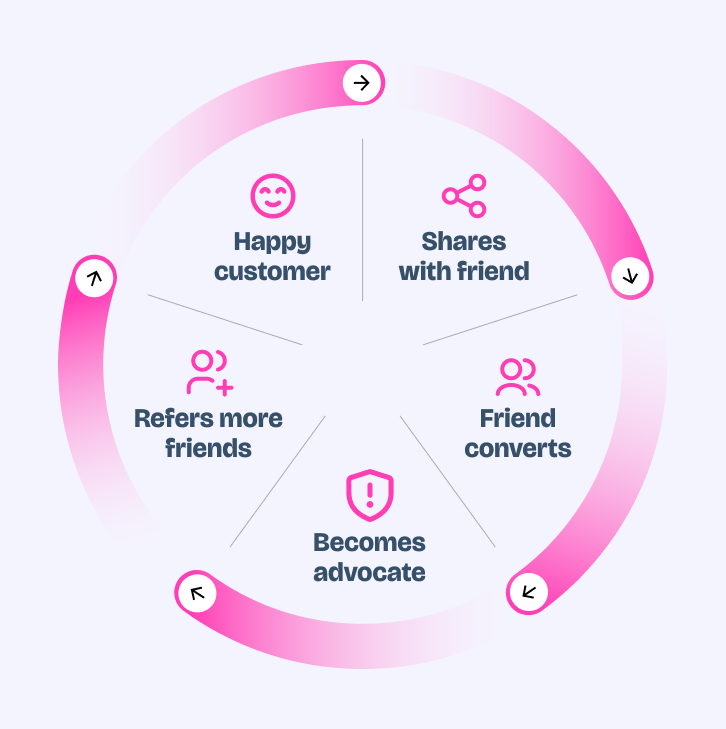
Getting the timing right matters. But thinking about referral as a single touchpoint? That’s a mistake. One-off campaigns produce one-off results. When referral is woven into every lifecycle stage, from onboarding to repeat purchase to loyalty tiers, it compounds over time.
Integrate referral prompts into your onboarding sequence, order confirmations, loyalty dashboards, and account settings. Huel’s results show exactly why: their referred customers introduce 2× more new shoppers than non-referred ones. That’s the self-reinforcing cycle in action.
4. Personalise Referral Experiences
Once referral is embedded across the journey, the next step is making each interaction feel personal. Generic “Refer a friend!” prompts underperform because they ignore context. Tailoring messaging, timing, and channels based on customer behaviour is one of the most impactful referral marketing best practices, and a hallmark of advanced referral marketing software. How big an impact does referral marketing have? 20% of your advocates drive 80% of referrals. The trick is knowing which 20%.
Moss Bros tackled this with Mention Me’s machine-learning-powered Smart Experiment feature. High-propensity customers shared 6× more, while lower-propensity customers who received tailored offers were 23% more likely to repurchase.
5. Make Sharing Frictionless
Personalisation matters, but even the most targeted prompt will fail if sharing feels like hard work. Every extra step is a drop-off point.
Mention Me’s Name Share® takes this further by letting customers refer by simply sharing their name at checkout, capturing offline word-of-mouth that links and codes miss. For brands like Schuh, a third of all referrals now come through Name Share.
6. Continuously Test and Optimise Incentives
No programme should stand still. What works today may not work next quarter. Treat your referral programme like a performance channel that needs constant iteration, testing incentive value, reward type, and messaging, one variable at a time. Data from over 45,000 A/B tests across the Mention Me platform shows that structured testing boosts performance by 6× on average.
PUMA’s testing uncovered a valuable insight. Their German and French audiences were more motivated by “give” messaging, while English audiences responded more strongly to “get” messaging. Without testing, that nuance would have been invisible.
7. Integrate Referral Data with Your CRM and Marketing Stack
Finally, all of these plays work harder when the data flows into your wider marketing ecosystem. Connect your referral platform to your CRM, email, and paid media tools so first-party insights inform segmentation, audience building, and lifecycle campaigns.
PUMA integrated Mention Me with Emarsys, allowing referral data to fuel personalised campaigns across all channels. The result? 6× ROI, with referred customers 4× more likely to refer onwards. Choose referral marketing software that connects with platforms like Salesforce, Klaviyo, Braze, or Shopify Plus to unlock this compounding effect.
Good Referral Marketing Examples (And What You Can Learn From Them)
Theory is useful, but results are what matter. The best referral marketing guide needs real-world proof to back it up, so here are three brands whose programmes show these plays in action.
|
Brand |
What They Did |
Results |
Plays Used |
|
Huel |
Double-sided discounts for both referrer and referee, embedded across the customer lifecycle with Name Share® |
22% of customers actively refer; 60% conversion rate; referred customers introduce 2× more shoppers; 12% YoY referral revenue growth |
Plays 1, 3, 5 |
|
PUMA |
CRM-integrated programme across 6 European markets, with A/B testing by cohort and Emarsys integration |
6× ROI; referred customers 4× more likely to refer onwards; launched in just 36 days |
Plays 4, 6, 7 |
|
Moss Bros |
ML-powered Smart Experiment targeting customers by propensity to refer, with Ometria integration |
High-propensity customers share 6× more; referred customers spend 14% more; 90% ROAS increase |
Plays 4, 6, 7 |
The common thread? Referral is treated as a strategic channel, not an afterthought. Huel mastered double-sided incentives and lifecycle integration. PUMA pioneered CRM-connected testing across markets. Moss Bros used AI-powered targeting to serve the right message to the right customer. Each programme earns growth rather than buying it.
How to Build a Strong Referral Marketing Strategy (Putting These Plays Into Action)
Knowing the plays is one thing. Here’s a practical referral programme strategy framework to put them into action.
Define your CAC and growth goals
Start by benchmarking your current CAC by channel and setting a target for what percentage of new customers you want referrals to deliver. Mature programmes typically drive 10–25% of new acquisition. Aim for an LTV:CAC ratio of 3:1 or higher.
Choose the right incentive model
Select a reward structure that aligns with your product and margins. Double-sided discounts work well for ecommerce. Tiered or milestone-based rewards drive gamification and higher volumes. Product-native rewards cost less to deliver and reinforce your value proposition.
Identify key referral moments
Map your customer journey and pinpoint two to three high-satisfaction moments where a referral request feels natural. Post-purchase, post-positive-review, and loyalty milestones are the most reliable triggers.
Launch and promote
Don’t simply launch it and hope customers find it. Promote your programme through email campaigns, in-app banners, social channels, and even packaging inserts. Treat the laun
ch like a product launch. PUMA went live across six European markets in just 36 days.
Measure and optimise
Track the core referral marketing tactics metrics: share rate, referral conversion rate, CAC by channel, and LTV of referred vs. non-referred customers. Use these insights to run A/B tests and continuously improve.
Ready to grow through customer advocacy rather than paid acquisition alone? See how 500+ brands are cutting CAC with advocacy-first strategies. Explore the Mention Me referral platform!
Conclusion
The CAC crisis isn’t a temporary blip. Rising ad costs, tightening privacy, and declining consumer trust are structural shifts that will only accelerate. A robust referral marketing strategy offers a powerful alternative. By implementing these seven plays, you build a self-reinforcing engine where every new customer has the potential to bring in the next. Referred customers cost less to acquire, convert at higher rates, spend more, and stay longer. In 2026, the brands that win will be the ones that earn their growth through customer advocacy, not just buy it through ads.
FAQ
What is a referral marketing strategy?
A referral marketing strategy is a structured plan for encouraging existing customers to recommend your brand, defining incentives, timing, channels, and measurement to drive advocacy.
How does referral marketing reduce CAC?
Referral marketing reduces CAC by turning customers into acquisition agents. Referred leads convert 3–5× more often than paid traffic, cutting CAC by 30–70%.
What is a good referral conversion rate?
A good referral conversion rate in ecommerce sits between 4% and 8%, with top programmes exceeding 9% — far above paid traffic's 1.8–2.5%.
What makes a referral marketing strategy effective?
An effective strategy combines the right incentive, perfect timing, and seamless sharing. It treats referral as an always-on growth engine, not a short-term campaign.
How do you choose the right referral incentive?
Choose an incentive that feels valuable to customers yet commercially sustainable. Double-sided rewards usually perform best, aligned to average order value and tested regularly.
When should you launch a referral marketing programme?
Launch once you have satisfied customers, a product people enjoy recommending, and clear post-purchase sharing moments. Launching too early limits impact and scale.
Why is referral marketing more trusted than other channels?
Referral marketing is more trusted because recommendations come from people consumers already know. That personal endorsement shortens the path to purchase and boosts conversion.
Dan Barraclough
Read more >
Share:




.png)
Table of contents
Share:
.png)