

When was the last time you shared something on your Instagram story versus the last time you sent a friend a WhatsApp saying "you need to try this"?
If you're like most people, the WhatsApp came more recently, and it mattered more. That gap is exactly why having a big social following and having a referral channel are two very different things, even though most brands treat them as the same.
The assumption goes like this: followers engage with your content, so they must be advocates who'll recommend you to their friends. Sometimes, sure. But usually there's a missing step in between.
A follower consumes what you post. An advocate tells a specific person to buy it. Getting from one to the other takes more than a good feed and a nice discount code.
Here's how to build that bridge properly.
Why social media is both your best and worst referral channel
On paper, social media should be the perfect home for referral marketing. It's where people share things with their networks, where they discover brands through people they trust, and where a lot of purchase decisions get made.
But here's the catch: sharing something publicly and recommending it personally are not the same act.
Think about it from the follower's side. When someone reposts your content to their 800 followers, they're broadcasting. The people scrolling past don't have a relationship with the person doing the sharing, so the trust that makes referral so powerful in the first place, the "my mate wouldn't steer me wrong" feeling, barely survives the trip.
Where does that trust actually survive? In the private layer. The WhatsApp message that says "have you seen this?" The DM to a mate with a product link. The group chat where someone raves about a new find. That's dark social, and it's where word-of-mouth on social platforms genuinely lives, whether or not you can see it happening.
So if your referral programme is built entirely around public sharing, you're optimising for the smaller, less trusted slice of the pie.
The two types of social media referral
Worth separating these clearly, because they behave completely differently.
Public social referral is a customer sharing your brand, product, or referral link on their profile, story, or feed. Good reach, low trust per person who sees it. Great for building awareness with people who've never heard of you.
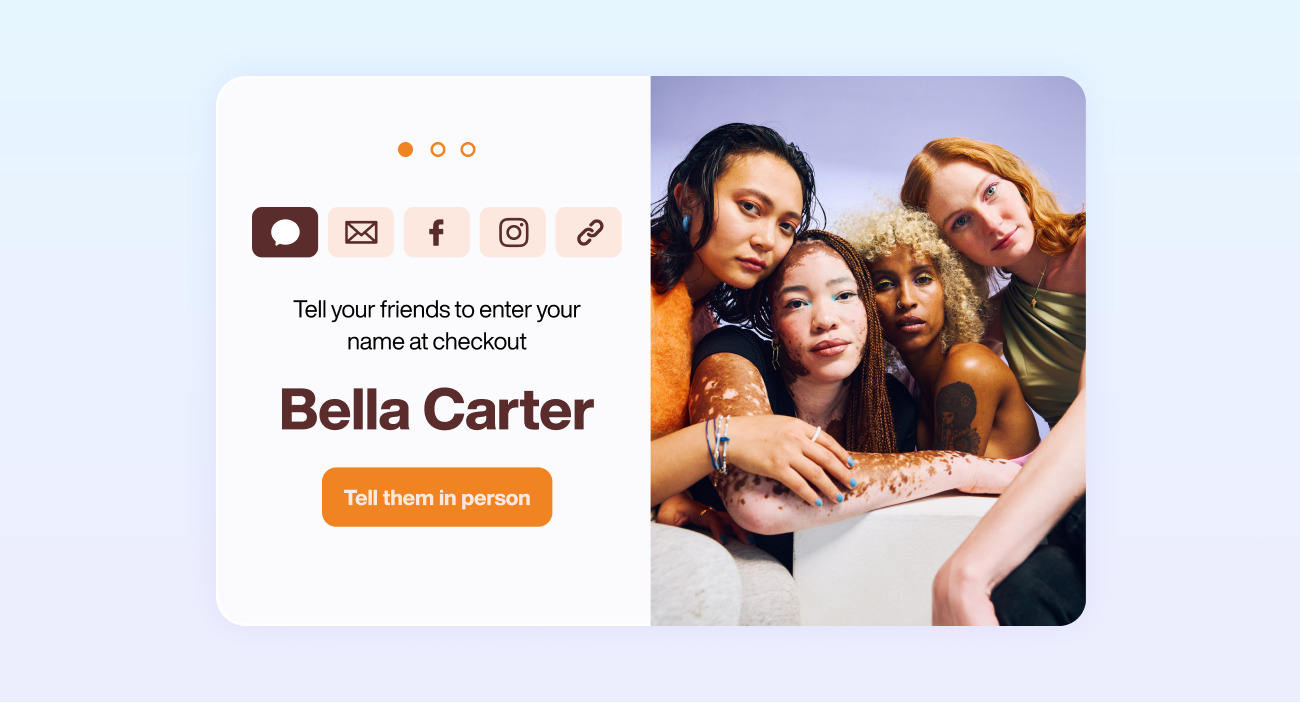
Private social referral is a customer sharing a recommendation directly with a specific person: a WhatsApp message, a DM, a text. Small reach, high trust. This is where the actual conversions tend to come from, because there's a real relationship behind the recommendation.
Most referral programmes are built entirely around the first one. Which is a shame, because the highest-converting activity is usually happening somewhere they're not even looking.
How to build a social media referral programme that captures both
Step 1: Make private sharing as easy as public sharing
Most referral programmes hand customers a link and a row of social buttons: Instagram, Facebook, X. Fine for public sharing. Useless for private sharing.
To actually capture what's happening in DMs and group chats, you need:
A pre-populated WhatsApp share option, since that's where most private mobile sharing happens in the UK A way to track referrals that doesn't rely entirely on a link, because links sent in private messages often don't get clicked, get forwarded without any attribution, or get replaced by a spoken recommendation the link was only ever backing up Name-based sharing as a fallback, so a customer can just say "mention my name" instead of relying on a friend to click a tracked URL
Make private sharing effortless and more of it happens. And because it converts better than public sharing, every bit of friction you remove is worth the effort.
Step 2: Target by advocacy propensity, not follower count
Here's a question worth sitting with: would you rather have a customer with 50,000 followers who reposts you once, or a customer with 200 followers who privately tells five close friends and all five buy?
Reach and advocacy are not the same thing, and chasing the wrong one gets you the wrong result.
The customers actually worth targeting tend to share a few traits: they've engaged with your content consistently over time, their purchase history suggests they genuinely love the brand rather than just browsing it, and they already share things in posts or stories without being asked. Find those people instead of chasing macro-influencers, and your referral economics improve fast.
Step 3: Time your ask around moments of genuine advocacy
Most brands treat their social channels like a megaphone: "share our refer-a-friend programme with your followers!" That's a weak ask landing on a cold audience, and most people scroll straight past it.
A much stronger move is catching people in the moment they're already advocating. Someone who's just tagged you in a post about a product they love? They're in an advocacy state right now. Someone who's just left a glowing comment on your new collection? Primed. Someone who's already shared their experience in a story? They've basically started the referral for you.
Reach those people, at that moment, with something frictionless to share, and you'll convert far better than any blanket campaign ever will.
Step 4: Let your social data sharpen your referral targeting
Your social data knows things your CRM doesn't. What people engage with, what kind of products they post about, which communities they're part of. All of it is a signal for who's likely to advocate and when.
Even a basic integration between your social engagement data and your referral targeting noticeably improves who you're activating and how efficiently you're doing it.
Step 5: Go after the referrals that happen off-platform
Here's the part that trips most brands up: the actual conversion often doesn't happen on social media at all. Someone sees a friend's recommendation on Instagram, searches your brand directly, and buys. The referral happened on social. Your analytics call it direct traffic.
Without the right attribution set up, that referral is completely invisible. The advocate gets no credit. Your programme quietly undersells its own performance, every single day.
Name-based attribution at checkout picks up a chunk of this. A simple "how did you hear about us?" survey after purchase picks up more. Put the two together and you get a much truer picture of how much of your revenue is actually being driven by word-of-mouth on social.
What a working social referral programme actually looks like
When it's built properly, you'll see activity on both layers.
Publicly: customers sharing products in stories and posts, community content driving discovery among people who've never heard of you, organic reach getting a genuine boost from real advocacy.
Privately: WhatsApp shares, DMs, and spoken recommendations driving your best-converting referrals, picked up through name-based attribution and post-purchase survey data.
Here's the uncomfortable bit, though: you'll never see all of it. Dark social is dark for a reason. The goal isn't total visibility, it's capturing as much as you realistically can, while building a programme around how people actually share rather than how you'd like them to.
The social referral metrics worth tracking
Share rate by channel. Of everyone shown a referral ask, what percentage share, and through which channel? A weak WhatsApp share rate compared to email might mean your WhatsApp mechanic needs work, not that your customers don't care.
Dark social attribution rate. What percentage of new customers say they were referred by a friend in a post-purchase survey, versus what percentage you actually capture through link or name attribution? That gap tells you exactly how much referral activity you're currently missing.
Conversion rate by referral source. Do referrals from private sharing (captured via name share) convert differently to referrals from public sharing (captured via link)? Usually, private wins by a distance. Knowing that for certain tells you where to invest.
Retention of customers referred through social. Customers who arrive via a genuine personal recommendation tend to stick around longer. Tracking this by referral origin proves whether that's true for your brand, and gives you the numbers to justify investing more in the private-sharing mechanics driving it.
The honest limitation
Let's not pretend social referral marketing doesn't have a ceiling, because it does. Organic reach on most platforms has dropped hard over the last few years. Even a customer who genuinely wants to share your content might find the algorithm decides their friends never see it.
So what's the answer? Lean harder into the private sharing mechanics: WhatsApp, DMs, name share. These haven't been touched by the algorithm, because there's no algorithm standing between a message and the person it's sent to. A friend-to-friend recommendation sent privately converts exactly as well today as it did five years ago.
Build your social referral programme around that reality, and you'll be outperforming every brand still pouring effort into the public sharing mechanic the algorithms have spent years strangling.
Dan Barraclough
Read more >
Share:





Table of contents
Share: