



Whether on TikTok, YouTube or Instagram, for switched-on brands, influencer marketing has become one of the most reliable engines for driving revenue, loyalty, and long-term customer value.
The size of the global influencer marketing market has more than tripled in the last five years – from $10bn in 2020 to $32.5bn today – as more brands discover the power of micro-influencers with small but highly engaged audiences. And on platforms with upwards of two billion active users, this really matters.
A generic display ad is as good as shouting into the void. But collaborating with a niche creator on content designed to resonate with their audience actually delivers results. And you don’t even need to completely overhaul your marketing strategy to unlock this impact…
From setting objectives and sourcing creators to delivering powerful campaigns that drive long-term value, this guide serves as your end-to-end influencer marketing strategy blueprint.
Table of contents
Foster authentic relationships
Define clear objectives and target audience
Before you do anything else, clarify two things: what do you want to achieve? And who do you want to reach?
Missing this step is one of the primary reasons your influencer campaign will underperform – so avoid the temptation to skip directly to the exciting parts like creator sourcing and content creation.
That’s because crystal-clear objectives make it easier to select the right creators, sell them your vision, measure results, and build a program that supports long-term customer retention – not just short-term reach.
The best influencer marketing examples were built on clear objectives and drove massive revenue growth.
Set SMART goals
Every high-performing influencer marketing strategy is built on Specific, Measurable, Achievable, Relevant, and Time-bound (SMART) goals. They turn vague ambitions – boost awareness, drive more sales, grow loyalty – into focused targets with a clear definition of success.
Here are some examples of SMART influencer marketing goals:
- Increase your repeat-purchase rate from influencer-acquired customers by 15% within 90 days
- Generate 1,000 qualified site visits from TikTok creators as part of your TikTok strategy
- Achieve a 25% uplift in Instagram saves to support your Instagram marketing strategy
SMART goals anchor your strategy, giving you the benchmarks you need to optimise performance and justify investment in your social channels.
Identify your target audience
The strongest strategies are also built around who you want to attract, not just who you want to work with. Your target audience should guide every decision, from platform selection to content style.
That’s why the next step is to define your audience using:
- Demographics: age, gender, location
- Psychographics: interests, beliefs, lifestyle, values
- Behavioural signals: purchase history, browsing habits, loyalty indicators
- Platform preferences: what are their preferred social channels and how do they like to use them? It could be a mixture. E.g: TikTok for discovery; Instagram for inspiration
Suppose your retention strategy is focused on turning first-time buyers into loyal customers. In this case, you might look for creators whose audience already shows an interest in repeat-purchase categories (such as beauty, fashion, home, wellness) rather than chasing broad reach on YouTube or experimenting with creators who don’t match your customer profile.
Select the right influencers
Too many brands value follower counts, jump on whoever feels trendy, or rely on surface-level metrics that don’t predict performance. Don’t be that brand.
A strong end-to-end influencer marketing strategy isn’t about finding the biggest creators. It’s about finding the ones your customers trust, listen to, and actually buy from. Ultimately, they drive better engagement, higher conversion rates, and significantly stronger retention.
Remember: Relevance beats reach. Authenticity beats aesthetics. Trust beats trend.
Prioritise relevance, authenticity, and engagement
A creator's value comes from their influence, not just their popularity. An influencer with a small but highly engaged audience has much greater power to drive meaningful action than one with millions of passive followers. And the stats bear that out: the engagement rate of creators with between 1,000 and 5,000 followers is much higher than those with any other audience size.
The best creators for your influencer marketing campaign strategy tend to demonstrate three core qualities:
1. Relevance
Does the creator naturally speak to the audience you want to reach? This goes beyond following your category – it’s about how they align with your customers’ motivations, aesthetic preferences, and daily habits.
For example, a skincare brand might prioritise creators with consistent get-ready-with-me routines, strong sentiments in the comment section (“this cleared my skin”), and audience demographics that match your ideal buyer, rather than partnering with a big-name beauty vlogger who just promotes products.
2. Authenticity
Audiences are hypersensitive to forced sponsorships. Look for creators already talking about products that are similar to yours, demonstrate genuine enthusiasm, and have a track record of creating compelling product-based content.
Some key signals of authenticity are:
- Real discussions in their comments – “Does this work for oily skin?” “I bought this because of you”
- Consistently posting content in your niche – demonstrating that they have a genuine interest and don’t just jump on any new paid opportunity
- Natural storytelling and a channel or feed that feels lived-in – rather than constant promotional content, do they regularly post content designed to connect with followers rather than just sell to them
3. High-quality engagement
Engagement rate – the total number of engagements (likes, comments, shares) divided by total number of followers or impressions x 100 – is a useful metric, but it doesn’t tell the whole story. Is that engagement meaningful? Look for:
- Conversations in the comments, not just emoji reactions
- Genuine curiosity, not spam from bots
- Repeat commenters, not inflated metrics
- Stable growth, not suspicious spikes that could be a sign of purchased followers or engagement
On YouTube, deeper signals like views-to-subscriber ratio or average view duration can tell you whether an audience is genuinely paying attention.
Use influencer marketing platforms
While manual research still matters, you can access much deeper and more reliable data by using influencer marketing platforms. These platforms provide tools for everything from creator discovery to content collaboration and performance measurement – making it easier to manage campaigns and relationships at scale.
Here are some of the top influencer marketing platforms for 2026:
Mention Me Influencer
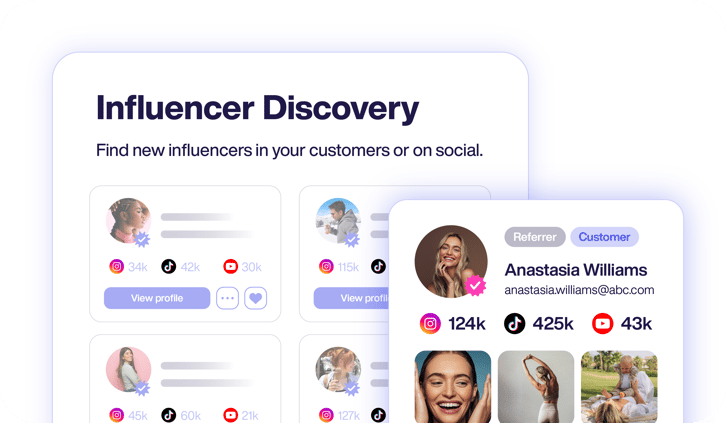
Mention Me Influencer is an end-to-end platform that helps you regain control of your narrative by discovering, engaging, and managing brand-fit micro-influencers at scale.
It aligns creators with authentic, on-message briefs, monitors content in real time, and ensures brand consistency across social, UGC, and referral channels, turning influencer activity into measurable growth and long-term relevance.
Mention Me Influencer is ideal for enterprise brands, but it's also one of the leading influencer marketing tools for SMBs.
GRIN
GRIN is a creator management platform that helps brands streamline discovery, outreach, shipping, payments, and reporting from one unified workspace. With its AI assistant, Gia, brands can quickly find creators, automate workflows, and optimise campaigns for measurable revenue impact.
Modash
Modash is a Shopify-focused influencer marketing platform that simplifies creator discovery, outreach, tracking, and payments in one easy-to-use dashboard. With access to 250M+ profiles and built-in tools for bulk emails, promo codes, and global payments, it’s perfect for Shopify brands running micro-influencer programs at scale.
Social platform creator marketplaces
TikTok, YouTube and Instagram all have their own creator marketplaces that allow you to use rich data to source top-performing creators, collaborate on content, and handle contracts and payments.
Foster authentic relationships
Once you’ve identified the best creators for your brand, you need to nurture those relationships so they strengthen over time. Transactional, one-off campaigns rarely deliver the trust, conversions, or retention you need for long-term success.
But when creators feel valued, empowered, and genuinely connected to your mission, everything improves: the content, the messaging, the performance metrics, and ultimately, customer loyalty. And the deeper the partnership, the stronger the results.
Here’s how to create relationships that compound over time.
Give influencers creative freedom
If you want creator-led content that actually performs, resist the urge to control every frame. Understand why influencers share content in the first place. Creators know their audience – how they talk, what they react to, and which storytelling formats generate the highest watch time and strongest purchase intent. Your role is to provide structure, not scripts.
Creative freedom is the backbone of every great influencer marketing campaign strategy. Here’s what it looks like in practice:
|
Brand |
Influencer |
|
Shares the why for the campaign: aims and objectives |
Determines how to achieve those aims and objectives |
|
Shares the claims, hooks, CTAs, and brand guardrails |
Decides pacing, tone, aesthetic, and narrative style |
|
Approves content for accuracy, not voice or style |
Delivers compelling content in line with the brief |
Communicate clearly
Creators perform best when they know exactly what you expect and what they can expect from you. Clear communication prevents misalignment, delays, and revisions, saving everyone time and ensuring the content feels authentic rather than manufactured.
A clear communication strategy should include:
- Timelines, deliverables, posting dates – so creators know exactly what’s expected and when.
- Usage rights and amplification details – to clarify how and where their content may be repurposed.
- Mandatory messaging and claims – ensuring accuracy, consistency, and compliance across content.
- Product education – giving creators the context they need to speak confidently and authentically.
- Dos and don’ts – outlining compliance requirements and industry-specific rules helps to avoid missteps and protect your brand.
- How you measure success – so creators understand the KPIs they’re working towards.
Engage with influencer content
If you want creators to feel like partners rather than vendors, you need to be part of the conversation. Brands often forget that engagement is a two-way street – when you interact with influencer content, it signals alignment, boosts algorithmic reach, and strengthens the long-term relationship.
This builds social proof and makes creators feel valued, which is the key to building always-on partnerships that outperform one-off or sporadic campaigns.
- Comment meaningfully, not generically: Leave thoughtful, context-specific comments that show genuine appreciation for the creator’s work, rather than generic emojis or praise.
- Answer audience questions the creator can’t address: Jump into the comments to clarify product details, restocks, or shipping info so the creator isn’t left handling customer support questions alone.
- Reshare high-performing content: Amplify standout posts by sharing them across your own channels to extend their reach and show creators that you value their work.
- Tag creators in your posts, newsletters, or Stories: Tagging creators gives them visibility and reinforces the authenticity of the partnership to your wider audience.
- Spotlight them in your brand channels or community spaces: Feature creators in blogs, emails, or community groups to deepen relationships and position them as trusted advocates.
Pay influencers fairly
Fair compensation builds trust, attracts higher-quality creators, and fosters loyalty over time. Underpaying or negotiating too aggressively is one of the fastest ways to damage relationships with talented influencers and limit your pool of trusted collaborators.
Fair pay is especially important when developing a micro influencer marketing strategy, where creators often deliver massive commercial impact relative to their size.
Fair partnership structures could include:
- Flat fees – guaranteed payment for agreed deliverables.
- Performance bonuses – extra rewards tied to hitting sales or engagement targets.
- Affiliate commissions – earnings based on tracked link or code-driven conversions.
- Revenue share – the creator receives a percentage of every sale generated by their content.
- Usage rights fees – compensation for allowing your brand to repurpose their content.
- Long-term retainers – consistent monthly payments for ongoing collaboration.
Create engaging content
Great content isn’t about perfection – it’s about creating something that resonates. The most effective creator collaborations feel native to the platform, aligned with the creator’s voice, and deliberately structured to spark engagement and drive action.
Collaborate on unique content
High-performing content blends your brand’s value proposition with the creator’s personality, storytelling style, and expertise. This means moving beyond generic unboxings or product mentions and collaborating on the kind of moments that only this creator could deliver.
This could be a unique twist on a popular trend or content that dives deeper into how they incorporate your product or solution into their everyday life. Think beyond the one post: plan creative hooks or story arcs on TikTok; on Instagram, it could be a concept for a carousel or reel.
Offer exclusive discounts and promotions
Exclusive offers give creators a compelling reason to inspire action, and their followers an incentive to act now rather than later. This works especially well in a micro influencer marketing strategy, where tight-knit communities respond strongly to exclusivity and personalised rewards.
Discounts and promotions also provide trackable attribution data so you can compare creator performance across platforms and campaigns.
Here are some ways you can make use of promotions without sacrificing your brand’s credibility:
- Unique discount codes tied to each creator – feel personal and authentic to the creator’s community, rather than looking like a generic mass promotion.
- Limited-time promotions – create urgency without seeming gimmicky, because the offer is genuinely exclusive to that creator’s audience.
- Bundles available only through influencer links – add real value instead of just slashing prices, helping promotions feel curated rather than desperate.
- Early access perks for creator communities – reward loyal followers with privileged access, reinforcing trust rather than undermining the creator’s authenticity.
Run contests and giveaways
Giveaways and contests are another simple but powerful way to boost engagement, reach new audiences, and deepen loyalty – especially when structured to reward meaningful interactions.
High-impact contest formats could include ‘comment to enter’ with a question that sparks conversation, user-generated content challenges (‘show us your setup’, ‘your version of this look’), and creator-hosted giveaways that require saving, sharing, or following. Reward-based contests that highlight repeat customers or loyal fans are also a good idea.
Optimise and measure
Even the best influencer marketing strategy requires continuous refinement to keep delivering. Once campaigns go live, you need to shift focus from planning to performance. That means analysing what worked, what didn’t, and how to scale the tactics that actually had an impact on revenue and retention.
And it’s not just about data: it’s about sharpening your strategy so every creator, piece of content, and pound spent delivers maximum commercial impact.
Track performance metrics
Focus is key when it comes to tracking performance. There are so many things you could track, but if you’ve outlined your objectives and set SMART goals, you should know which metrics actually matter.
As well as showing you which creators, formats, and platforms drive the strongest commercial outcomes, this data can also show which to deprioritise – saving you time and money in the long run.
For most brands, these core metrics are worth tracking:
- Engagement rate to understand content quality and audience fit
- Click-through rate (CTR) to measure interest and intent
- Conversion rate to see how effectively creators drive action
- Average order value (AOV) and lifetime value (LTV) to assess long-term customer value
- Cost per acquisition (CPA) and Return on advertising spend (ROAS) to benchmark creators against paid channels
Use a central CRM tool
Your CRM is the connective tissue between influencer activity and customer behaviour. Integrating creator-driven traffic and conversions into a central customer system allows you to see whether influencer-acquired customers buy again, spend more, or recommend your brand to others. This is especially important for retailers building loyalty-focused influencer marketing strategies, where repeat behaviour matters more than one-off sales.
Reserve budget for scaling
Organic reach is unpredictable, so leave a bit of breathing room in your budget to amplify creator content that’s already resonating. Paid boosts on TikTok, Instagram, YouTube, or Meta can turn a strong post into a high-performing acquisition asset. This extends the shelf life of your content, stabilises results, and helps your influencer marketing campaign strategy scale beyond the creator’s audience.
Negotiate UGC rights
If you don’t secure usage rights early, you limit your ability to repurpose top-performing creator content across ads, landing pages, email, and paid social. Negotiating rights upfront ensures you can use every winning asset wherever it has the greatest impact – without undermining trust or risking compliance issues. This also stretches your influencer budget further by turning organic content into multi-channel assets you can use time and again.
Think beyond the campaign
Short-term activations can secure traction, but long-term programmes drive loyalty. Use your insights to inform always-on relationships, build creator cohorts, and create repeatable playbooks for ongoing collaborations. The more consistent these partnerships are, the more recognisable and credible your brand becomes, and the stronger your retention lift over time.
Iterate and refine
Once you’ve gathered the data, it’s time to translate your insights into smarter decisions, sharper briefs, and more profitable creator partnerships. Iteration is where good programs become great, and where brands begin to see compounding returns in both acquisition and retention.
Analyse campaign performance
Look beyond top-line metrics and dig into why certain creators, formats, and messages performed the way they did. Identify patterns: which hooks held attention, which platforms drove repeat purchases, which creators influenced higher-value customers, and where drop-offs occurred. This analysis will inform your roadmap for what to scale, what to adjust, and what to retire.
Adapt to changing trends
Influencer marketing moves fast — algorithms shift, formats evolve, and audience behaviour changes. Keep your strategy flexible to changing trends by regularly testing new features, experimenting with emerging creators, and refreshing creative approaches. Brands that adapt quickly stay culturally relevant and maintain influence long after competitors plateau.
Roundup
A winning influencer strategy starts with clear goals, the right creators, and authentic collaboration, then builds momentum through high-performing content and constant optimisation. When done end-to-end, influencer marketing isn’t just a discovery channel - it drives repeat purchases, loyalty, and lasting customer value.
The brands that truly succeed treat it as an always-on growth engine. By learning from every campaign and nurturing long-term creator partnerships, your program compounds over time, boosting retention, strengthening loyalty, and creating a marketing ecosystem that keeps growing stronger.
Henry Williams
Read more >
Share:





Share:
.png)
.png)
.png)