



TikTok isn’t just another social platform – it’s where over 1.5 billion people discover new brands, trends, and products every month.
Facebook, Instagram and Youtube might still lead in user numbers, but with 192 million downloads in Q2 2025 alone (second only to ChatGPT globally), its influence is exploding.
But it’s not just about the numbers. TikTok’s algorithm rewards creativity and authenticity over big budgets; creators who speak your customers’ language over slick scripts and polished ads. That’s what makes its content so powerful for your brand.
TikTok videos made by influencers with highly engaged audiences drive more valuable conversations, longer watch times, and, ultimately, higher ROI.
For retailers, it delivers scalable reach, built-in social proof, and measurable conversions without a full overhaul of your marketing strategy.
But to make it work, you need to find the right influencers and adopt a collaborative, results-driven approach. Here’s how...
Table of contents
How to find and vet TikTok influencers
How to create TikTok influencer campaigns
Action plan for marketing leaders
The strategic imperative for 2026
Getting started with TikTok: Building a strong influencer marketing foundation
When you begin building your TikTok influencer marketing strategy, the first thing to do is lay solid foundations. Follow these steps for long-term success:
1. Clarify your objectives
Before you do anything, identify your primary objective. You can have more than one, but trying to do too much at once forces you to spread your resources too thin. It also means the creator you partner with has to deliver on an impossible brief.
The result? Lacklustre campaigns and meagre results. Better to be laser-focused on a single goal, along with a handful of complementary, secondary targets.
For example:
- Brand awareness
- Qualified traffic
- First-purchase sales
- Repeat orders
- Retention
- Loyalty
2. Validate audience-platform fit
TikTok has masses of potential for retail brands – but is it the most effective way to reach your target audience and achieve your objectives? Use TikTok Insights and your own analytics to confirm that there’s a demographic and interest overlap with your customers. Over 50% of users are aged between 18 and 30 – so, if your audience is Gen Z or millennials, there’s a good chance that it’s the right strategy for you.
3. Choose the right influencer tier
Looking like a good fit? Great, let’s refine our strategy further by choosing an influencer tier that aligns with your objectives. TikTok influencers can roughly be broken down into the following brackets:
- Micro (10k–100k): high trust, strong comments, great for trials, reviews, and conversions.
- Mid-tier (100k–1M): a nice balance of reach and authenticity; ideal for launches and evergreen proof.
- Macro (1M+): an easy way to achieve wide reach and spark cultural moments; pair with retargeting and Shop to capture demand.
You can also mix tiers to hedge risk or achieve a balance of different objectives. For example, a base of micros for reliable sales, a few mids for scale, and selective macros for spikes.
4. Establish KPIs (early)
Define what success looks like by translating your objective into a clear KPI with one or two supporting metrics. For example, brand awareness = content engagement rate (total likes, comments, and shares, divided by total views, multiplied by 100). The average content engagement rate on TikTok is 4.64%, so you can use that as a benchmark.
You could also measure traffic and sales by CTR, conversion rate, CPA/CPP, or incremental revenue. Or you could measure loyalty by repeat purchase rate, time-to-second-order, and LTV uplift among referred cohorts – whatever is the most valid measure of success at this point in your brand’s journey.
The important thing is that your KPIs are Specific, Measurable, Achievable, Relevant, and Time-bound (SMART).
How to find and vet TikTok influencers that drive reach and loyalty
It’s hard to overstate how important finding the right influencer is to the impact of your campaign. And no, that doesn’t just mean they have a ton of followers.
You can increase your chances of discovering your perfect match by following these steps.
1. Research creators
Start by researching creators who naturally align with your brand. Explore hashtags related to your product category or values, e.g. #SkincareRoutine, #OOTD, or #HomeHacks, to identify possible collaborators.
From there, head to TikTok Creator Marketplace, the platform’s own search and analytics hub. It allows you to filter creators by audience demographics, location, engagement rate, and category, so you can narrow down your long list to only the most suitable candidates.
If your approach is to identify creators on Instagram first and then apply those insights to TikTok, influencer marketing platforms like Mention Me Influencer can help you discover talent that matches your criteria. You can use AI and advanced filters to find creators, analyse their performance with rich data, and instantly contact hundreds of potential partners via direct message or email.
2. Assess creators using a criteria checklist
Now, you have a shortlist of very promising potential collaborators. But hold up. Before reaching out, you need to assess each creator’s quality through four lenses:
Do they have an authentic audience? Review comment sections and follower growth patterns. Healthy engagement ratios and genuine interactions are better indicators of influence than sheer follower count.
Is their engagement of a high calibre? Look for comments that reflect interest and trust (“I bought this because of you,” “This actually works”) rather than generic emojis or spam.
Are they consistent? Check how often they post and whether their style or values align with your brand tone. Sporadic posting or sudden topic shifts could spell trouble for your campaign and the stability of your working relationship.
Does their tone align with your brand? The creator’s humour, language, and aesthetics should feel like a natural extension of your brand, not a forced partnership. Followers are loyal and highly attuned to the creator’s output. They’re sure to disengage at the first whiff of inauthenticity.
3. Use AI-powered tools to detect fake followers or inflated engagement
Authenticity is a two-way street, but unfortunately, some creators pay to artificially inflate their followers or engagement to appear more popular and land bigger brand deals.
Luckily, there are tools for vetting exactly this kind of activity. For example, Mention Me Influencer uses AI to analyse audience authenticity, comment patterns, and location data to flag suspicious activity.
You can also use Mention Me’s integration-friendly analytics to compare influencer performance across your campaigns, helping you distinguish genuine advocacy from inflated metrics.
4. Prioritise long-term relationships
Creators aren’t equivalent to ad slots – they’re brand partners who should evolve alongside your campaigns.
The strongest results come from ongoing creator partnerships, not one-off posts. When influencers have time to experience your product, their advocacy feels more genuine, and their followers notice.
Long-term collaborations build familiarity, deepen storytelling, and generate more data that you can use to refine your creative strategy. But like any relationship, both parties must work at it to make it last.
Clear communication, consistent results, and incentives like inviting them to new launches or loyalty initiatives are a sure-fire way to drive engagement and growth.
How to create TikTok influencer marketing campaigns to build authentic engagement and lasting loyalty
Now it’s time for the fun part: collaborative creation. Provided you’ve committed time to research, due diligence, and building strong foundations, you should be in a good place to kickstart a campaign that delivers meaningful results.
Here are our top tips for creating influencer marketing campaigns.
Empower creators
Resist the urge to be hands-on or micromanage every element of the campaign. There’s a reason you partnered with this creator, so give them the space to do what they do best. When influencers choose to work with you, this is one of the biggest factors.
What does that look like in practice? Instead of prescribing scripts or overly detailed briefs, share the why behind your brand and let influencers shape the how and what. Share campaign goals and critical dos and don'ts, but leave the creative direction to them. That leads to organic content, rather than overly-orchestrated videos that can be a big turn-off for followers.
Content formats that convert
TikTok rewards variety, so test multiple creative styles to see what resonates with your audience. This is by no means an exhaustive list, but these high-converting formats are a good place to start:
- Tutorials and how-tos: Creators can educate their followers about your brand through quick, value-led tips that naturally integrate your product. For example, a skincare routine or cooking tutorial
- Unboxings and first impressions: Real-time, emotional reaction videos elicit a visceral response from viewers that lingers in their minds for a long time after watching .
- “Day in the life” storytelling and behind-the-scenes content: By giving their followers an even more intimate insight into their world, influencers create deeper connections with followers, all the while subtly positioning your brand as part of their lifestyle.
- Challenges or trends: Jump on trending content formats to piggyback on viral moments. A small twist on a familiar trend often sparks exponential reach. Just be careful to ensure it doesn’t feel inauthentic.
Lastly, don’t forget to encourage creators to tag your brand, use campaign hashtags, and repurpose high-performing clips for paid amplification or cross-channel storytelling.
Blend entertainment and brand purpose
TikTok users come for entertainment first, so even branded content needs to make them smile, learn, or feel seen. The secret to a powerful influencer marketing strategy lies in striking a balance between brand purpose and the platform’s culture of humour, trends, and storytelling.
Encourage creators to weave your message into relatable narratives or trends, combining brand value with engaging content. For example, a skincare brand might join a self-care trend to talk about confidence, while a fashion retailer could use humour around “outfit fails” to showcase wardrobe solutions.
Advanced TikTok tactics: Scaling your campaigns for measurable growth
The above tips are a great starting point, but if you want to scale your influencer campaigns to deliver growth over the long term, you need to deploy these advanced tactics.
Always-on influencer programmes
When you find a high-performing creator, invest in them with always-on influencer marketing campaigns. Use insights from early activations to identify creators who consistently deliver high engagement or strong conversion.
These ongoing collaborations allow you to double down on your most valuable relationships, creating a steady stream of authentic content. This keeps your brand visible in the algorithm and deepens bonds with followers.
Additionally, securing trusted, reliable collaborators for new seasons or product launches means you don’t have to waste time scoping out and building new relationships every time.
Cross-platform integration
Maximise your ROI by repurposing TikTok content across other channels. The same authentic short-form video that performs well on TikTok can fuel your integrations likeMeta Ads, YouTube Shorts, email campaigns, or website landing pages to boost consistency and efficiency.
This cross-channel approach keeps your message unified and amplifies high-performing creator assets far beyond TikTok’s reach. See how Mention Me enables seamless integration with your essential customer platforms, making it easy to activate, nurture and retain your loyal fans.
Data-driven optimisation
Data is your feedback loop. Use performance dashboards and attribution models to compare influencer ROI by creator, content type, and audience segment. Over time, you can use this data to refine creative briefs, incentive structures, and targeting.
Focus on the right stats, not vanity metrics like views. Engagement rate, CTR, conversion rate, and incremental revenue uplift should be your bread and butter. By feeding this insight back into future campaigns, you’ll spend smarter and grow faster.
Creator seeding and ambassador programmes
The short bursts of exposure you achieve through influencer marketing are all well and good, but you need to go beyond paid collaborations by ‘seeding’ products to emerging creators who already love your brand. Genuine enthusiasm often translates into free, high-performing user-generated content.
From there, formalise those relationships through ambassador programs, where you invite select creators to represent your brand over the long term. This approach builds a community of advocates who continually share, review, and co-create with you, turning exposure into sustained loyalty ecosystems.
Leverage TikTok Shop and affiliate links
TikTok Shop and affiliate links enable direct, first-party conversion tracking for purchases completed within the platform’s ecosystem. This has a few implications. Firstly, you can see exactly which creator, post, or product mention drove a purchase, making it easier to quantify ROI and optimise in real time.
Secondly, and perhaps more importantly, it presents a massive advantage to brands operating in a landscape of changing cookies and tracking.
Google might have abandoned plans for a full phase out of third-party cookies on Chrome (though Safari and Firefox do block them), but it still plans to give users more control over their privacy through enhanced settings. So, because tracking happens directly within TikTok’s ecosystem, you can still capture accurate, first-party performance data without relying on third-party cookies.
Measuring success and TikTok influencer marketing ROI
You already set your goals and defined your KPIs. Great. Now, it’s time to see if your campaign actually delivered, but don’t be disheartened if you don’t hit your targets first time - it’s a chance to learn, iterate, and improve.
Choose your attribution models wisely
Attribution models are how you assign credit for conversions or revenue to marketing touchpoints. Different models complement different types of campaigns. You could use one or a combination of the following:
Promo codes – these unique discounts or offer codes for each creator are the simplest and most familiar option. They’re quick to set up and easy for audiences to remember (“Use code LARA10 for 10% off”). Beyond tracking direct conversions, promo codes add personality and urgency, creating a sense of exclusivity between the influencer and their followers.
UTM links – UTMs let you see how each creator’s traffic behaves once it hits your site – whether it’s browsing, adding to cart, or converting. UTMs feed data straight into analytics platforms like the Mention Me Executive Dashboard, which you can use to track core advocacy metrics like revenue generated by referred customers, rewards issued, and share and conversion rates.
This gives you a clearer picture of engagement quality, not just quantity. They’re perfect for understanding which creators are driving the most meaningful traffic, even if not every click turns into an instant sale.
Affiliate tracking – Affiliate programmes take attribution a step further, tying every click and purchase directly back to the influencer through cookies or unique IDs. They’re ideal for long-term partnerships where you want to reward performance transparently and fairly.
For both brands and creators, this model builds trust: everyone sees what’s converting, and creators are incentivised to keep promoting products they genuinely believe in.
Define your metrics
Track a mix of reach, engagement rate, click-through rate (CTR), and conversions to measure the impact of creator content across the funnel.
Beyond top-line metrics, calculate cost per acquisition (CPA) and lifetime value uplift (LTV) to understand how referred or influenced customers perform over time. TikTok’s own analytics, paired with your CRM data, can reveal whether influencer-driven customers convert faster, spend more, or stay loyal longer.
Calculate the true ROI of your campaign
Remember: views are vanity, ROI is what really matters.
To calculate influencer ROI, compare total campaign cost (creator fees, product seeding, incentives, management time) against revenue directly attributed to influencer activity.
Then, benchmark your results against paid social averages to contextualise performance. If your influencer CPA is lower, or your influencer-acquired customers show higher retention or LTV, you’re building sustainable growth.
Make use of powerful tools and dashboards
Modern influencer programs rely on real-time visibility. Dashboards that combine TikTok analytics, CRM insights, and sales data allow you to track engagement and conversions through to purchase and beyond.
Platforms like Mention Me make monitoring your influencer marketing analytics easier by connecting referral, influencer, and performance data in one view, helping you attribute value to every creator and optimise campaigns with confidence.
Common pitfalls of TikTok influencer marketing and how to avoid them
TikTok’s fast-paced, creative environment rewards authenticity and connection, but it’s easy to get carried away as a retailer chasing results, especially when you’ve already had some success.
Below are some of the most common mistakes brands make when running influencer campaigns, along with practical ways to avoid them.
|
Pitfall |
Why it Happens |
How to Avoid it |
|
Over-controlling creator content |
Avoid over-scripted videos or rigid guidelines that strip away a creator’s natural tone. The result is content that feels like an ad and underperforms. |
Share a clear brief with key messages and outcomes, but let creators interpret it in their own style. Trust their instinct for what resonates with their followers. Authenticity always outperforms polish on TikTok. |
|
Ignoring audience comments |
After a campaign goes live, don’t overlook the conversation happening in the comments. This is where valuable feedback emerges and is a great chance for brands to join the conversation. |
Assign someone to monitor and respond to questions or reactions. A simple “Thanks for trying it!” or “Here’s where to find it” builds brand warmth and drives organic engagement. |
|
Lack of measurement planning |
Without tracking links, promo codes, or baseline metrics, it’s impossible to know what success looks like. This can make your influencer marketing campaign seem “unproven.” |
Set up your tracking framework before launch. Use UTMs, affiliate dashboards, and post-purchase surveys to capture both direct and assisted conversions. Measure ROI just as you would for paid social. |
|
Focusing only on virality |
It’s tempting to chase loads of views, but viral hits don’t always translate into loyalty or long-term sales. |
Prioritise relationship metrics (repeat mentions, LTV uplift, referral rate) alongside reach and engagement. Consistent creators who drive small, steady wins often outperform one-hit wonders. |
Future trends in TikTok influencer marketing
In 2026 and beyond, retail brands like yours need to stay on top of shifting trends in influencer marketing in order to stay relevant. Because what’s working today won’t always deliver results tomorrow.
The rise of niche creators and community-driven content
The days of one-size-fits-all influencer campaigns are giving way to micro-communities and community-driven content. Engagement rates for niche creators (micro and nano influencers) still outpace many bigger names, meaning relevance trumps size every time.
A Statista report found that influencers with between 1,000 and 5,000 followers had a higher engagement rate (2.19%) than influencers with any other audience size.
That’s why, instead of casting a wide net or targeting maximum follower count, smart brands are diving into interest-specific corners of TikTok and partnering with creators who live and breathe those niches.
According to TikTok’s 2025 What’s Next report, this shift toward ‘Brand Fusion’ emphasises working with creators who bring cultural relevance and trust, not just follower counts.
Live shopping and TikTok Shop integration for retail
E-commerce and influencer content are merging faster than ever on TikTok. The integration of live-stream shopping, shoppable videos, and creator-led commerce is opening up new opportunities for conversion and loyalty.
For retail brands, this means influencer campaigns can now feed directly into commerce – not just awareness. A follower who engages with your campaign via your partner creator’s latest video could be buying something from you just a few clicks later.
After all, around 49.7% of TikTok social-shoppers purchase at least once per month – that’s more frequently than Facebook or Instagram.
AI-assisted campaign analytics and creator matchmaking
Data, not just creativity, is taking centre stage. AI tools are enabling brands to find creators whose audiences align, predict performance, monitor authenticity, and optimise in real-time. According to benchmark reports, over 66% of marketers expect AI integration to improve campaign outcomes.
So what are you waiting for? Mention Me’s end-to-end Micro-Influencer platform uses unique first-party referral data and AI vetting to help you discover powerful advocates for your brand from within your own community.
Then you can track campaign performance via customer emails and voucher codes, which, unlike cookie-based tracking, give a real picture of success.
A growing emphasis on sustainability, inclusivity and transparent partnerships
TikTok’s users – especially Gen Z and younger Millennials — care deeply about values. Authenticity isn’t just about a creator’s voice: it’s about alignment with values like sustainability, diversity, and ethical conduct. Brands that genuinely embody these themes see stronger advocacy and deeper engagement.
Authenticity is key. That’s why you must:
- Make sure to choose creators whose values reflect your brand’s purpose – don’t just be seduced by their follower count.
- Be transparent about paid partnerships and demonstrate authenticity over the long term rather than one-off campaigns.
- Build communities around trust and shared values, which ties directly into loyalty – not just one-time conversions.
Influencer marketing action plan for retail marketing leaders
Here’s your step-by-step influencer marketing action plan:
1. Define goals & audience fit
Start with clarity: decide whether your TikTok influencer activity is aimed at awareness, sales, or loyalty – then confirm your audience is active on the platform.
2. Vet and partner with creators
Choose creators who genuinely align with your brand values and speak to your target customers. Prioritise engagement quality over follower count.
3. Co-create authentic content
Collaborate, don’t dictate. Give creators space to express your message in their own voice while keeping key themes and calls to action consistent.
4. Track KPIs and ROI
Use promo codes, UTMs, and integrated dashboards to measure reach, conversions, and lifetime value uplift – not just vanity metrics.
5. Scale through recurring collaborations
Build long-term partnerships with high-performing creators. Always-on relationships turn one-off campaigns into continuous, compounding brand loyalty.
Case study: How Dalfilo scaled authentic influence with Mention Me
The brand
Dalfilo, an Italian home retailer known for premium textiles, wanted to turn everyday customers into powerful brand advocates.
The goal
Originally, Dalfilo used macro-influencers to build awareness. But as costs rose and ROI declined, the team shifted focus to micro-influencers – creators with smaller but more engaged audiences who could drive authentic connections and repeat sales.
The challenge
However, scaling its micro-influencer programme proved challenging. Manually finding and managing hundreds of micro-influencers was too slow and unsustainable. Traditional affiliate tools lacked visibility and control, making it difficult to track content, payments, and performance at scale.
Egle Delsanto, Growth Marketing Manager, Dalfilo: “It was becoming really time-consuming and difficult to manage and scale a micro-influencer programme ourselves. That’s where Mention Me was able to jump in.”
The solution
With Mention Me’s AI-powered influencer platform, Dalfilo can now:
- Discover hundreds of micro-influencers in minutes – many of them existing loyal customers already excited to promote the brand.
- Capture and manage content automatically – every tag, story, and post is stored in one place, with no risk of losing valuable user-generated content.
- Simplify payments and transparency – influencers have full visibility over earnings, eliminating the friction of older affiliate systems.
- Integrate seamlessly with referrals – so customers acquired through influencers often go on to refer others.
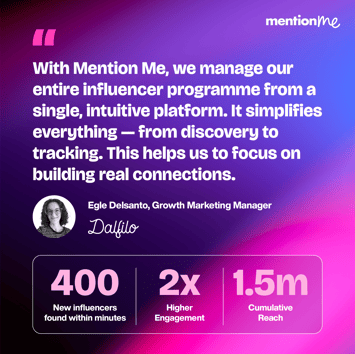
Delsanto: “With Mention Me, we manage our entire influencer programme from a single, intuitive platform. It simplifies everything — from discovery to tracking — so we can focus on building real connections.”
The results
- 400 new influencers discovered within their customer base in minutes.
- Twice the engagement rates compared to industry averages among Mention Me-sourced creators.
- Dalfilo’s influencer community has a collective reach of 1.5 million.
Thanks to Mention Me, this influencer marketing example with Dalfilo proved that you can turn influencer marketing from a manual process into a scalable, loyalty-driven growth engine.
The strategic imperative for 2026 and beyond
For retailers, TikTok influencer marketing is no longer the experimental option – it’s a measurable, scalable growth engine, and it’s time you switched it on. As the platform continues to evolve into a full-funnel ecosystem for discovery, engagement, and purchasing, TikTok influencer marketing will become an indispensable ingredient in every retailer’s marketing mix.
The brands that win in 2026 will be those that invest early in data-driven creator partnerships, build loyalty ecosystems around authentic voices, and treat influencer advocacy as a sustained channel, not a trend.
Next steps:
- Run a small pilot campaign to test audience resonance and attribution models.
- Audit your current influencer activity to identify which creators and formats deliver genuine ROI.
- Book a strategy consultation with Mention Me to align influencer performance with your wider loyalty and retention goals.
FAQs
Why is TikTok influencer marketing a growth lever for retail brands?
TikTok’s blend of entertainment, community, and commerce makes it one of the most efficient channels for brand discovery and customer acquisition. Retail brands using TikTok influencer campaigns report conversion rates up to 2x higher than traditional social ads and stronger post-purchase retention. By tapping into creators who already have audience trust, brands can reach new customers in a way that feels natural and measurable.
What is TikTok influencer marketing?
TikTok influencer marketing is the practice of partnering with TikTok creators to promote products or services through authentic, short-form video content. Unlike influencer campaigns on Instagram or YouTube, TikTok’s focus on trends, sounds, and storytelling allows even small creators to drive massive organic reach. The result is a dynamic mix of entertainment and advocacy that feels native to the platform’s culture.
How does TikTok marketing work?
TikTok’s algorithm prioritises relevance over reach. It surfaces videos based on user interests – what they watch, like, and share – not follower counts. That means well-matched creator content can perform just as strongly as posts from big names. When influencers create genuine, story-driven videos, the algorithm amplifies them to audiences most likely to care, giving brands a consistent stream of qualified attention without heavy ad spend.
Henry Williams
Read more >
Share:




Share:
.png)
.png)
.png)