





Influencer marketing used to feel simple. Find creators with reach, pay them, hope the posts land. Then the spreadsheets grew arms and legs, finance started asking harder questions, and suddenly “awareness” wasn’t cutting it anymore.
Today, many brands using GRIN are quietly asking the same thing. Are big creator databases still worth it? Rising influencer fees, hazy attribution, cookie deprecation and board-level pressure on CAC and LTV are forcing a rethink. Not about creators, but about influence itself.
That rethink is pulling teams away from rented reach and towards something more dependable: owned customer advocacy. Real people who already buy from you, trust you, and can be tied directly to revenue. This is where platforms like Mention Me step in as a different way of thinking about influence altogether.
This guide breaks down the best GRIN alternatives for brands focused on ROI, first-party data, and proof that influence actually pays its way.
Jump to
What to look for in a GRIN alternative
How Mention Me goes beyond traditional influencer platforms
When does a GRIN alternative make sense?
What is GRIN? And why are brands looking for alternatives?
GRIN is a creator management platform designed to help brands discover, manage and pay influencers at scale. It does that job well. But it struggles when finance asks where the money came from.
GRIN’s core strength sits in workflow, helping teams find creators, run campaigns, manage relationships, track posts and handle payments. For brands running high-volume influencer programmes, that operational layer matters.
Where cracks start to show is further down the funnel. GRIN relies heavily on third-party creator data and campaign-based tracking, which makes it hard to tie influencer activity to long-term value, repeat purchases, or true incremental revenue.
As cookies disappear and paid reach gets pricier, that limitation hurts. Marketing leaders are no longer rewarded for activity. They’re rewarded for outcomes. And outcomes demand cleaner attribution, owned data, and a clearer line between influence and revenue.
If you want a broader grounding, it's important to understand what influencer marketing is to set the scene.
What should you look for in a GRIN alternative?
The best GRIN alternatives don’t just help you run influencer campaigns, but help you prove influence drives revenue, using data you actually own, which is why it's important to learn how to collect zero-party data.
If you’re nodding along to any of these, you’re not alone.
“We can’t prove influencer ROI to finance.”
“We’re overpaying for reach we don’t own.”
“Our best advocates are already our customers.”
These are structural problems that shape how you should evaluate alternatives.
First-party data ownership
Third-party creator databases age fast. Algorithms change, accounts go quiet. First-party data, on the other hand, compounds. Platforms built around owned data give you something future-proof, especially as privacy rules tighten, which is what we predict for the future of customer data.
Revenue and LTV attribution
Clicks are cheap. Customers aren’t. Look for platforms that can connect influence to actual orders, repeat purchase behaviour, and lifetime value, not just last-click conversions. Overall, it's vital to familiarise yourself with a breakdown of influencer marketing analytics.
Scalability without creator fatigue
Audiences get bored. Creators burn out. Systems built on advocacy spread influence across thousands of genuine voices, instead of hammering the same faces again and again.
Ability to replace multiple tools
The strongest alternatives don’t sit beside your stack. They simplify it with fewer dashboards, reconciliations, and awkward budget conversations.
Top GRIN alternatives compared
Most GRIN competitors still focus on creators. A smaller group focus on customers as advocates. That distinction changes everything.
Influencer platforms like GRIN
| Platform | Best For | Key Strength | Key Limitation |
|---|---|---|---|
| Mention Me | Advocacy-led growth | First-party advocacy and revenue attribution | Different mental model |
| Aspire | Creator discovery | Strong workflow UX | Third-party data reliance |
| Upfluence | Ecommerce teams | Influencer search | Weak attribution |
| CreatorIQ | Enterprise brands | Deep reporting | Expensive and complex |
Let's unpack what that actually means in practice.
Mention Me
Best for: Advocacy-led growth
Key strength: Narrative control powered by first-party advocacy and revenue attribution
Key limitation: Requires a shift in mindset
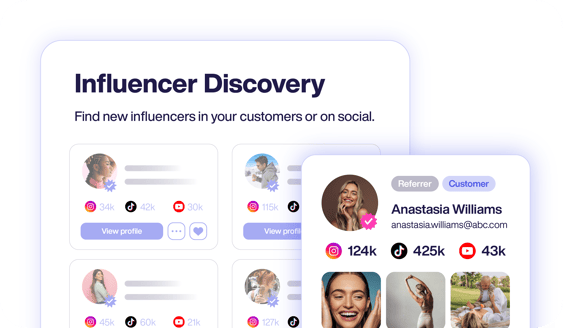
Mention Me is the influencer platform built for CMOs who feel their brand story slipping through their fingers. In a world where creators, customers and AI systems increasingly define how your brand is described, it puts you back in the driving seat. Not by shouting louder, but by aligning the right human voices around a clear, consistent narrative that AI can recognise and reward.
Rather than starting with cold creator databases, Mention Me activates brand-fit influencers who already care, alongside your most influential customers. These advocates are briefed, guided and monitored in real time, so what they say reinforces your positioning instead of diluting it.
The result is influence that feels human, stays on-message, and shows up coherently across reviews, social, forums and AI-driven discovery.
Crucially, this isn’t just about control for control’s sake. By treating public conversation as a strategic surface, Mention Me links narrative consistency to measurable revenue, LTV and demand quality.
For teams used to campaign thinking, that can feel like a different mental model. For teams under pressure to protect pricing power, improve CAC and stay visible in AI-led search, it quickly feels like the grown-up answer.
Aspire
Best for: Creator discovery
Key strength: Workflow UX
Key limitation: Third-party data
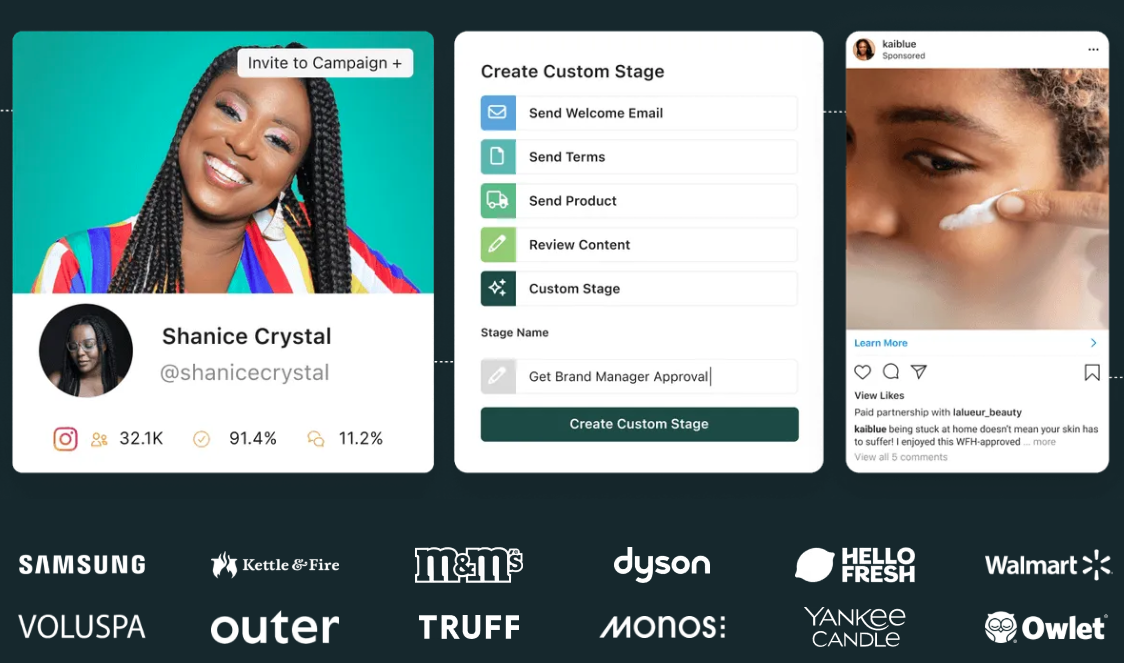
Aspire does a solid job of bringing order to influencer chaos. If your team spends half its life juggling briefs, contracts, approvals and follow-ups, its workflow-first approach feels like a breath of fresh air. Everything is where you expect it to be, and day-to-day execution runs smoothly.
The trade-off is what sits underneath that workflow. Aspire still depends on external creator databases and platform signals to drive discovery and performance. That means you’re optimising for what algorithms surface, not necessarily for what drives long-term value for your brand.
Attribution tends to stop at campaign results, which makes it harder to understand how influence compounds over time or feeds into LTV. Efficient, yes. Enlightening, less so.
Upfluence
Best for: Ecommerce teams
Key strength: Influencer search
Key limitation: Weak attribution
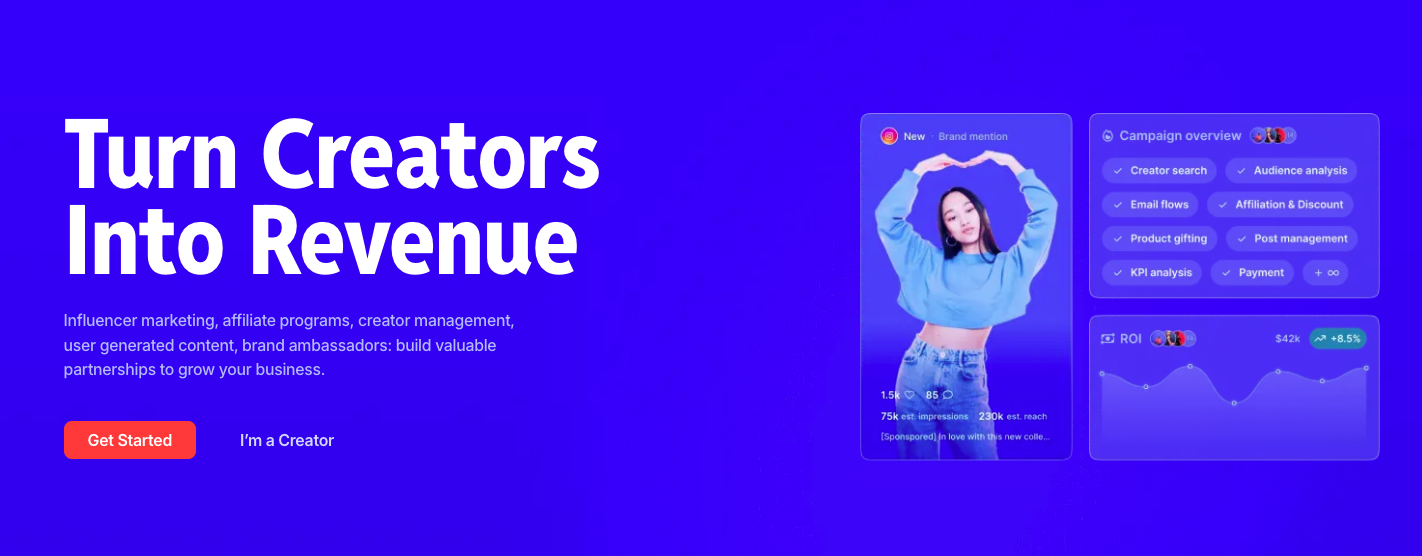
Upfluence appeals to ecommerce teams because it feels close to revenue. Its integrations make it easy to spot creators who already buy your products, which is a sensible starting point. There’s something reassuring about working with people who have already voted with their wallet.
Where it starts to wobble is measurement. While it can tell you who posted and who clicked, the path from influence to actual customer value remains fuzzy. Revenue attribution beyond basic tracking is limited, and understanding whether an influencer drives repeat purchases or higher-quality customers often involves manual work.
For teams being asked tougher questions about payback periods and LTV, that lack of clarity can quickly become frustrating.
CreatorIQ
 Best for: Enterprise brands
Key strength: Reporting depth
Key limitation: Expensive and complex
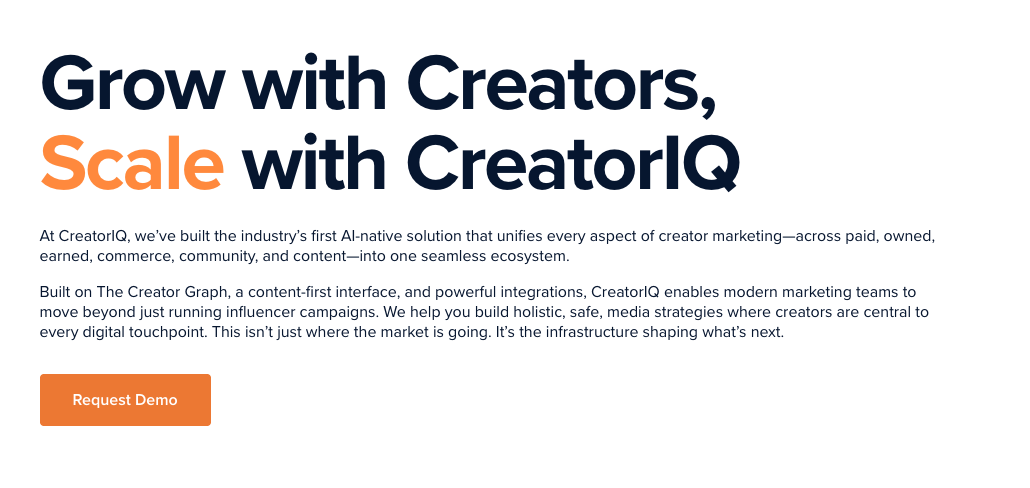
CreatorIQ is built for scale. Big brands with global footprints, multiple regions and strict governance requirements value its depth, controls and reporting capabilities. It’s a serious piece of kit, designed to keep large influencer programmes compliant and visible.
That depth comes with weight. Implementation is rarely light-touch, and the platform demands time, budget and internal buy-in to run well. While reporting is detailed, much of it still centres on activity and exposure rather than owned data or long-term customer impact. For organisations already wrestling with complexity, CreatorIQ can feel like adding another layer rather than simplifying the picture.
How Mention Me goes beyond traditional influencer platforms
Most GRIN alternatives try to help you find more influencers. Mention Me helps you identify the customers who already grow your business, then turns their human influence into measurable revenue and AI visibility.
Traditional influencer platforms start with creators and hope customers follow. That made sense when discovery was driven by feeds and follower counts. It makes far less sense in an AI-led world where trust, reviews and real recommendations increasingly shape what gets surfaced.
Mention Me starts somewhere else entirely: with your customers. More specifically, with your Tru-Promoters™, the small group who already recommend you, buy again, create content unprompted and quietly drive a disproportionate share of growth. These are the voices both people and AI trust. The job is no longer finding influence. It’s recognising it, organising it, and scaling it without breaking what makes it work.
Customer to advocate identification
Most brands don’t know which customers actually help them grow. Mention Me does. The platform analyses behavioural, transactional and engagement data to surface customers who actively influence others, not just those who look influential on paper.
This goes beyond spotting who’s shared a referral once or tagged you on social. It identifies consistent advocates whose recommendations convert, whose content resonates, and whose influence compounds over time. These are your Tru-Promoters™, and they become the foundation of everything that follows.
AI-driven advocacy scoring
Once identified, advocates are continuously scored based on outcomes, not noise. Revenue driven. Repeat purchases influenced. Long-term value created.
This matters because budgets are tight and scrutiny is high. Scoring influence based on incremental impact means spend flows towards what actually grows the business, instead of being spread thin across creators who generate activity but little return. It also gives teams a shared language, one that finance understands without translation.
Referral and micro-influencer flywheel
Happy customers recommend friends. Some of those friends become loyal customers. A subset of those become advocates themselves. That’s the flywheel.
Mention Me connects referrals, reviews and micro-influencer activity into a single system, so advocacy compounds instead of resetting every campaign. Over time, this creates a steady stream of trusted, human-led signals across social, reviews, forums and private channels. Exactly the places AI systems increasingly learn from. Less chasing creators. More momentum.
Revenue attribution and LTV impact
This is where the model really breaks from traditional influencer platforms. Every advocacy action is tied back to revenue, retention and lifetime value. You can see which advocates drive high-quality customers, which messages convert, and where influence actually pays off.
The result is fewer assumptions and clearer decisions. Influence stops being a cost centre you defend once a quarter and starts behaving like a growth channel you can optimise with confidence.
GRIN vs Mention Me: Owned advocacy or rented reach?
GRIN helps you manage creators. Mention Me helps you build influence you actually own. At a glance, both sit in the influencer space. In reality, they solve very different problems.
GRIN and similar platforms are built around rented reach. You identify creators, run campaigns, track outputs, then start again. That model works when visibility is the goal and attribution expectations are low.
Mention Me is built around owned advocacy. It identifies the customers already shaping opinion, organises their influence, and turns it into a system that compounds over time. In an AI-driven world, that distinction is becoming hard to ignore.
Here’s how the two approaches differ in practice.
Third-party creators vs first-party customers
GRIN relies on external creator databases and platform signals you don’t control. Influence lives outside your ecosystem, shaped by algorithms, incentives and individual agendas.
Mention Me focuses on first-party customers who already trust your brand and advocate for it organically. Their behaviour, data and impact are yours to understand and build on. That makes influence more stable, more credible, and far easier to defend when budgets are reviewed.
Campaign bursts vs always-on advocacy
Influencer platforms like GRIN are designed for campaigns. You brief, activate, report, then reset. Each campaign stands largely on its own.
Mention Me runs as an always-on system. Advocacy doesn’t switch off when a campaign ends. Tru-Promoters™ continue to refer, review, create content and influence new customers, feeding a steady flow of trusted signals into both human and AI-led discovery.
Activity metrics vs revenue metrics
When it comes to influencer marketing KPIs, GRIN excels at tracking outputs. Posts published. Engagement generated. Content delivered. Useful, but often disconnected from long-term value.
Mention Me ties influence directly to revenue, repeat purchase behaviour and lifetime value. That means you can see which voices actually grow the business, not just which ones generate noise. Influence is measured by what it changes, not what it produces.
Optimising for reach vs optimising for trust
GRIN optimises for reach and efficiency at the top of the funnel. That’s valuable when scale is the priority in your influencer marketing ROI.
Mention Me optimises for trust, relevance and demand quality. In a market where AI agents increasingly decide what brands get surfaced, those trusted, human-led signals become a competitive advantage rather than a by-product.
If your KPIs still revolve around impressions, engagement rates and content volume, creator platforms like GRIN will feel familiar. If your KPIs are CAC, LTV, payback period and AI visibility, owned advocacy starts to look like the safer long-term bet.
When does a GRIN alternative make sense? And when does it not?
Switching platforms makes sense when influence is expected to behave like a commercial channel. It makes less sense when you’re still finding your feet.
When it does make sense
If influence spend is under board-level scrutiny, first-party systems come into their own. If cookie deprecation is already affecting performance, owned data becomes a safety net rather than a nice-to-have. And if influencer costs keep climbing while returns flatten, continuing as you are becomes hard to justify.
When it might not
Brands early in their influencer journey may still benefit from simpler creator tools. Testing formats, creators and channels can be quicker without heavier systems in place.
There’s also a trust angle. Over-automation can drain authenticity if it’s handled badly. This piece on AI influencer marketing and customer trust is a useful reminder that control and credibility need to move together.
Balanced programmes exist. The key is being clear about what role influence plays in your growth model.
FAQ: GRIN alternatives and influencer platforms
Is GRIN still worth it in 2026?
For brands managing large volumes of creators, yes. For brands that need clean revenue attribution, it often falls short.
Are influencer platforms being replaced by advocacy tools?
Not entirely. But many brands are shifting budget towards advocacy systems because the returns are easier to prove.
How do you measure influencer ROI accurately?
By linking influence to orders, repeat purchases and lifetime value, not just clicks or codes.
Can customers really outperform influencers?
In many categories, yes. Customers bring trust, relevance and credibility that paid creators often struggle to match at scale.
Replace influencer spend with owned advocacy
Influencer marketing still has a role to play. But in an AI-driven world, the brands that win are the ones whose growth doesn’t depend on rented attention.
Mention Me helps you identify the customers who already drive your growth, turn their advocacy into trusted signals that both people and AI respond to, and connect that influence directly to revenue, retention and lifetime value. Fewer assumptions. Clearer answers. Influence you can actually control.
If you’re under pressure to improve CAC, prove ROI and stay visible as discovery shifts towards AI, it may be time to rethink where your influence budget really works hardest.
Book a free demo to see how Mention Me turns Tru-Promoters™ into your most scalable, defensible growth channel, and gives you the numbers finance will trust.
Dan Barraclough
Read more >
Share:





Share:

